You’re selling, the evaluator’s report has an electrical page, and some items are marked hazardous. Your buyer’s lender or insurer may already be asking about them, and the closing date isn’t moving.
At Northloom Minneapolis Knob and Tube, we correct the electrical items on Truth-in-Sale of Housing and point-of-sale reports in Minneapolis, St. Paul and nearby cities. We trace each item to its cause, correct it under permit where required, and document it for the sale.
A sale report is often the first time you see your wiring described in writing, and the first time your buyer sees it at all. A short list of items can turn into questions from a lender or an insurer, and a clear record of what we fixed answers them.
What happens when you come out?
We start with your report.
- The report
- We read each electrical item with you, along with its rating.
- Each item traced
- We find the outlet, box or fixture and identify the circuit behind it.
- The cause
- We work out whether it’s an isolated problem or a symptom of original wiring on that circuit.
- Your scope
- A written fix for each item, whether it needs a permit, and what it would cost to address alone or with related work.
What do the electrical items on my report usually mean?
Sale reports list conditions the evaluator saw during a walk-through, each with a rating. Electrical items tend to fall into a few groups.
| Item | What it usually means | Usual fix |
|---|---|---|
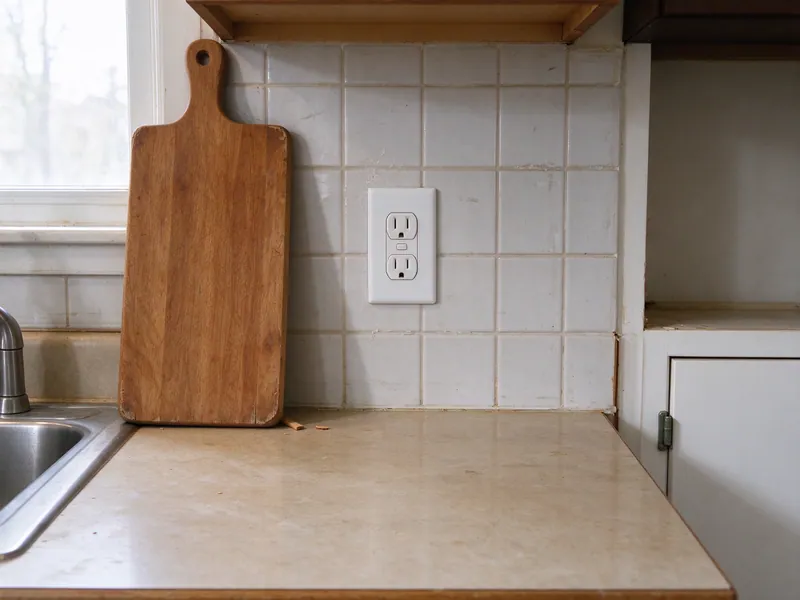
| Ungrounded three-prong outlet | A three-prong receptacle on a two-wire circuit | Labeled GFCI protection, a two-prong receptacle or a new grounded circuit |
| No ground-fault protection near water | Kitchen, bath, laundry or basement outlets without GFCI | GFCI receptacles or breakers |
| Open junction box or exposed splice | Missing cover, or wires joined outside a box | Cover plate, or the splice moved into a box |
| Missing smoke alarm | No working alarm where required | Hard-wired alarms installed under permit |
| Knob and tube visible | Original wiring seen in the basement or attic | Tracing first; the scope depends on what’s live |
| Overfused circuit | A fuse larger than the wire it protects | Correct fuse size, or a breaker panel |
Which items should I fix first?
Start with anything rated hazardous. Reports separate conditions by how serious the evaluator judged them, and a hazardous rating is what buyers, lenders and insurers notice first. St. Paul’s sample report, for example, rates ungrounded three-prong outlets in a kitchen as a hazardous condition. In Minneapolis, we confirm with the evaluator how the city’s sale evaluation rates each electrical item for your house.
What does St. Paul actually require me to repair?
Only one thing. St. Paul’s Truth-in-Sale of Housing report is prepared by a City-licensed private evaluator and must be available to buyers within three calendar days of listing. It’s valid for one sale within 365 days.
- Disclosure
- The report tells buyers about observed conditions. Most items don’t have to be repaired.
- Smoke alarms
- A single-family home without a working hard-wired smoke alarm must get one. The city’s rules call for it to be installed by a licensed electrical contractor under permit, with an inspection. We include the alarm, its permit and the inspection in your scope.
- Evaluators don't repair
- An evaluator can’t make repairs to a property they evaluated while that evaluation is valid.
- Who it covers
- Single-family homes, duplexes, condos, townhouses and co-ops.
Who handles the repairs, me or the buyer?
Who pays for and handles electrical items is part of the deal, and city rules shape it.
- Richfield
- The city’s point-of-sale program requires a housing inspection before closing. Required repairs are re-inspected before closing, or a buyer can take them on with a repair schedule and a cash escrow agreement, after which the city issues a certificate of compliance.
- St. Paul
- Beyond the smoke alarm, repairs are negotiated between buyer and seller.
- Minneapolis
- We confirm for each sale what the city’s evaluation requires, and when.
- Either way
- Our written scope and price for each item gives both sides something concrete to negotiate with.
Do the repairs need a permit if we’re closing soon?
Many do, and the closing date doesn’t change that. The permit runs through the usual office: the Minnesota Department of Labor and Industry in Minneapolis and many suburbs, the City of Saint Paul’s Department of Safety and Inspections in St. Paul, or the city’s own inspector where a suburb runs one. The request goes in at or before the start of work, and getting it in place is part of our job. A sale timeline makes skipping it tempting, but work started without the request carries a state investigation fee on top of the permit, and a closing is the worst time to discover unpermitted work.
Should I fix things before listing or after the report?
You can address electrical items at a few points, and each has its uses.
| When | Advantages |
|---|---|
| Before the evaluator arrives | The report describes corrected items, not hazards; the circuits are already traced if buyers ask |
| After the report, before listing | The work matches exactly what the evaluator wrote; permits and inspection fit before the house goes on the market |
| During the sale | Items can be negotiated, but permits and inspection have to fit the closing date |
If you already know your house has original wiring, it often pays to have us trace the circuits before listing, so you can answer buyers with a record instead of an estimate. The guide to selling a house with knob and tube compares replacing, documenting and pricing it in.
What if one item turns into a bigger job?
Some items are symptoms. An ungrounded outlet on a circuit that turns out to be original knob and tube, or a run of visible knob and tube in the basement, raises the question of how much original wiring is live. We trace to answer it, and the result may be confirmation that it’s dead, partial replacement, or a larger rewire you and the buyer negotiate around. When it’s a few circuits, our typical range for partial replacement is $3,000 to $10,000, about $750 to $2,500 a circuit, and you get a written estimate to put in front of the buyer. The guide to selling a house with knob and tube covers the options, and the TISH guide explains the reports in more detail.
The record from our correction work lists each report item, what we found behind it, what we did and under which permit. Buyers’ agents and lenders can read it against the report line by line.