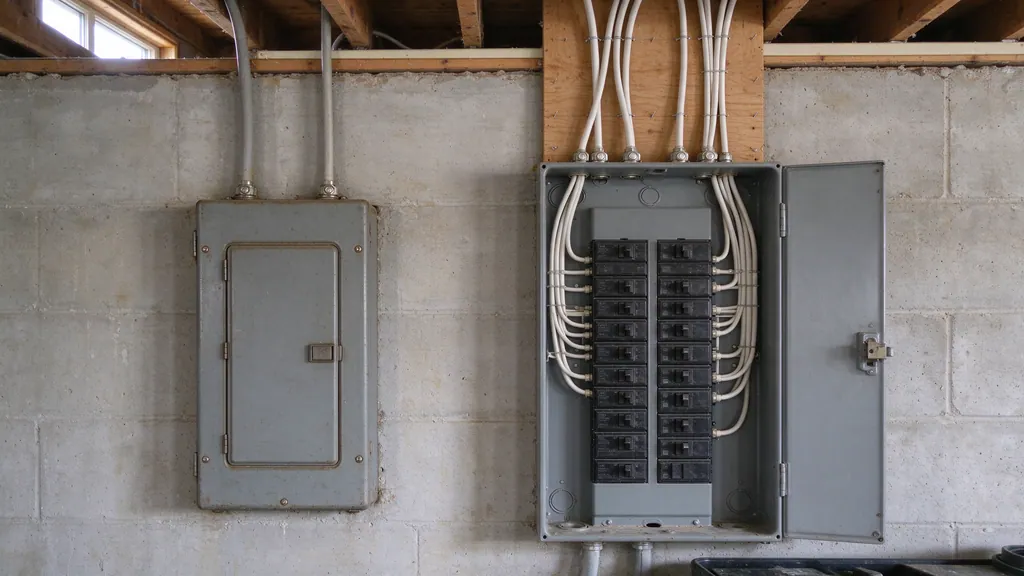
You replaced the fuse box, or you’re about to, and you want to know whether that takes care of the knob and tube. It doesn’t. A new panel changes what protects each circuit. The wires running from it to your bedrooms, kitchen and attic stay exactly as they were, now on a breaker instead of a fuse.
At Northloom Minneapolis Knob and Tube, we handle panel upgrades and rewires in Minneapolis and St. Paul, and we plan one around the other. This guide shows you the difference between the two, how we work out which one your house needs, and the order that keeps you from paying for the same work twice.
Why didn’t my new panel get rid of the old wiring?
Because the panel is the source, and knob and tube is in the branches. Picture your electrical system in three parts:
| Part | What it is | What a panel upgrade does to it |
|---|---|---|
| Service | The utility connection, meter and service entrance | Sometimes upgraded at the same time |
| Panel | Fuses or breakers that protect each circuit | Replaced |
| Branch circuits | The wiring from the panel to lights, outlets and appliances | Unchanged |
Knob and tube is branch wiring. When an insurer, a buyer or an insulation contractor asks whether you have it, they mean the branches, and a panel swap leaves every one of them in place.
Is a panel upgrade still worth doing?
Yes, when it’s done for the right reasons. A new panel fixes real problems at the source.
- Correct protection
- Breakers sized for each circuit’s wire, replacing oversized fuses.
- Room
- Spaces for arc-fault and ground-fault breakers and new circuits.
- Capacity
- With a service upgrade, enough power for air conditioning, a heat pump, an induction range or a car charger.
- Records
- A typed directory listing every circuit.
Our typical range for a panel and service upgrade, 100 to 200 amps, is $2,500 to $7,000. What moves it is the equipment, the meter and the Xcel Energy work.
What does the panel leave behind?
Everything past the breakers.
- Original wiring
- Every knob and tube run stays in service, ungrounded and as old as before.
- Splices
- Joints between original and later wiring stay where they are.
- Insulation conflicts
- Knob and tube in the attic still can’t be insulated around.
- Insurance question
- “Is any knob and tube energized?” still has the same answer.
This is where a lot of owners get caught. A listing that says “updated electrical” may mean a new panel feeding original circuits. We trace each circuit at the panel to show you which is which, so you know what you actually have.
How do you decide what my house needs?
We trace first, then match the scope to what we find.
| Tracing finds | What usually makes sense |
|---|---|
| Branch circuits modern; panel is a fuse box or full | Panel upgrade alone |
| Branch circuits modern; new loads planned | Panel and service upgrade |
| A few original circuits live | Partial replacement, with the panel changed if it lacks room |
| Original circuits feed most of the house | Whole-house rewire, with the panel changed at the end |
The partial versus full guide walks you through the branch-circuit side of that choice.
If I need both, what comes first?
The rewire, with the panel changed at the end. When original circuits are live and the panel also needs replacing, we work in this order:
- Trace every circuit.
- Size the panel and service from a load calculation that includes the loads you plan to add.
- Run the new branch circuits.
- Change the panel at the end, landing the new circuits on it directly.
- Disconnect the original circuits at their source and test them dead.
Doing the panel first means paying to land original circuits on new breakers, then moving them again when they’re replaced. If your panel has to come first because it’s failing, we plan it with room for the circuits to come.
Do I need a bigger service, too?
Only if what you run, or plan to run, needs it. A load calculation adds up what your house uses now and what you’re adding. Original circuits were sized for lights and small appliances. If you’re adding central air, a heat pump or a car charger, you need capacity at the service and circuits sized for those loads. The guide to modern appliance loads explains the numbers.
Who inspects the panel work?
The same office that inspects the rewire. In Minneapolis that’s the Minnesota Department of Labor and Industry, which adds $35 to the state fee for a service. In St. Paul it’s the city, at $85 a service. A service change also brings in Xcel Energy to disconnect and reconnect. When we combine a panel upgrade with a rewire, the permit and inspections stay together on one schedule.
Will a grant or tax credit pay for my panel?
Not right now. Minnesota has created a residential panel upgrade grant for income-qualified households, but it isn’t accepting applications yet, and it won’t cover work done before approval. The federal credit for qualifying panels ended for work placed in service after 2025. Neither program pays for replacing knob and tube. The rebates guide tracks both.
I still have a fuse box. Is that a problem by itself?
Not always. Many older Minneapolis houses still have a screw-in fuse box, and fuses protect well when they’re the right size. The usual problem is a fuse swapped for a larger one. A fuse box also can’t hold the arc-fault or ground-fault breakers new circuits need, so a rewire nearly always ends at a breaker panel, even when the fuse box itself is in decent shape.
How do I know my panel needs replacing anyway?
Some panels need to go no matter what the branch wiring is. Look for these:
- Oversized fuses
- Fuses larger than the wire they protect, often 20 or 30 amps on circuits made for 15.
- No spaces
- Every slot used, with doubled-up breakers or added subpanels.
- Heat or damage
- Discoloration, corrosion, a burning smell, or fuses and breakers that run warm.
- Small service
- A service sized for lights and a few appliances, with new loads planned.
- Location
- A panel without the working space the code requires in front of it, or in a closet or bathroom.
Any one of these puts the panel in your scope. When we trace the branch circuits on the same visit, you also find out whether the rewire belongs there too.
What about a duplex with a panel in each unit?
Treat each unit as its own question. Two- and three-unit buildings often have a panel or fuse box per unit, and sometimes a house panel for the common areas. Each can be upgraded on its own, but the branch circuits behind each one are separate. A duplex with new panels in both units can still have original circuits in one of them, and circuits that cross between units. We trace each unit to answer it.
What paperwork should I end up with?
One record that covers it all. Whichever scope you choose, it should list each circuit and whether it’s original or modern, the panel and service size, and the permit and inspection dates. That single document answers your insurer, your next buyer and the next electrician who opens the panel.
What should I ask before I sign a panel quote?
- Which circuits behind the panel are original, and how do you know?
- Does the quote include replacing any of them, or only the panel?
- Is the service size based on a load calculation?
- Will the panel have room for the circuits I plan to add?
- Is the permit included, and who coordinates with Xcel?
Panel upgrades covers how we do the work. Questions about your house: (612) 509-6597.