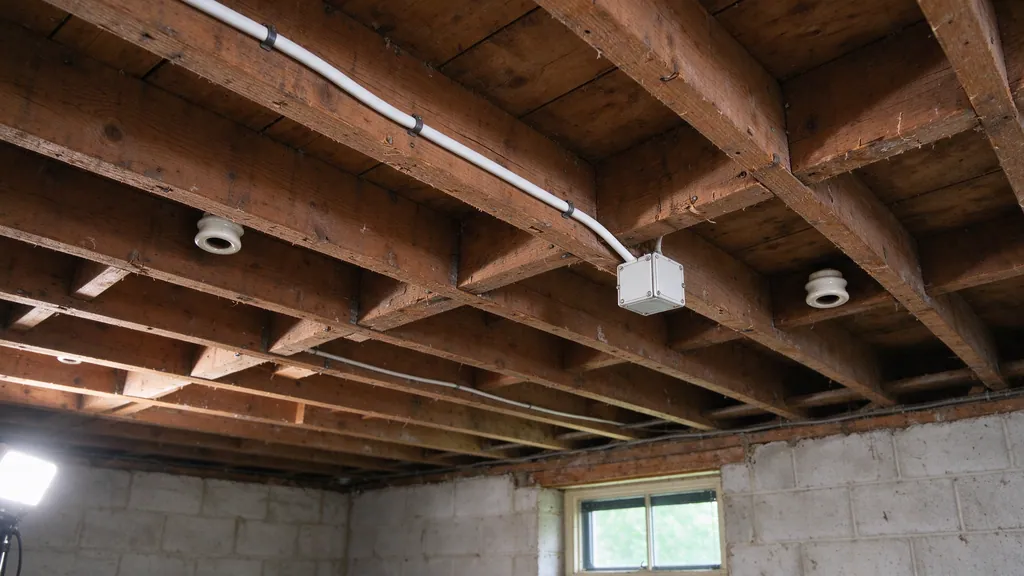
You’ve found out your house has knob and tube, and the first question is how much of it you have to deal with. Often the answer is less than you feared. If most of the house already runs on modern wiring and only a few original circuits are still live, replacing just those circuits can be enough.
At Northloom Minneapolis Knob and Tube, we do both partial and whole-house replacement in Minneapolis and St. Paul, and we don’t steer you toward either until we’ve traced your circuits. This guide shows you how we make the call, and how to make it with us.
How do I know which one my house needs?
By finding out how much of the old wiring is still live. Everything starts with the circuit list from tracing, which marks each circuit as live original, dead original or modern.
| What tracing finds | Usual choice |
|---|---|
| One to a few original circuits live, the rest modern | Partial replacement |
| Original circuits live on one floor or in one area | Partial replacement, possibly phased |
| Original circuits feed most rooms | Whole-house rewire |
| All original circuits already dead | Neither: confirm, record and remove exposed runs |
The last row surprises people. Sometimes the knob and tube you can see in the basement was disconnected years ago, and the job is to prove it dead and write it down, not replace anything.
When is a partial job enough?
When the old wiring is contained and your reasons for replacing it are met by removing what’s live.
- Contained
- The live original circuits serve a few rooms, often upstairs bedrooms or a front room.
- Panel room
- The existing panel has spaces for the new circuits.
- Insurer's question
- The carrier asks whether any knob and tube is energized, and replacing the live circuits makes the answer no.
- Plans
- A larger project is coming later, and the rest can be done then.
Partial jobs are common here for a simple reason. Minneapolis houses have often been rewired in stages over decades. About 70% of the city’s one- to three-unit buildings were built by 1939, and most have been remodeled at least once since, so many of them are already part way there.
When should I just do the whole house?
When the old wiring is everywhere, or something else in the house needs to change anyway.
- Widespread
- Original circuits feed most rooms on most floors.
- Tangled
- Later wiring is spliced into original runs throughout.
- Panel
- The house still runs on a fuse box, or the panel has no room.
- Requirements
- An insurer or buyer wants no original wiring left at all.
- Layout
- The house needs more outlets, kitchen and bath circuits, and protection everywhere anyway.
Past a certain point, a partial job costs nearly as much as a full rewire and leaves you with less. When your circuit list gets there, we’ll tell you.
Can’t you just replace the part I can see?
No, and this is how houses end up mixed in the first place. Whatever the scope, we work circuit by circuit. A partial job replaces each chosen circuit from the panel to every device on it, then disconnects the original at its source.
Replacing only a visible section, such as the run in a remodeled kitchen, can leave the same circuit’s original wiring feeding the rooms around it, sometimes through the very walls being rebuilt. You’d think the kitchen was done while the circuit behind it was still old.
How will anyone know what was replaced?
Because we write down the boundary. On a partial job, the record matters as much as the wiring.
| Record entry | Why it matters |
|---|---|
| Each new circuit and the rooms it serves | Shows what’s modern |
| Each original circuit replaced and where it was disconnected | Shows it’s dead |
| Any original circuits left in place, live or dead, and where | Answers insurers and buyers honestly |
| Permit and inspection dates | Shows the work was done properly |
Will my insurer accept a partial job?
That depends on the question your carrier asks, and carriers differ. Many ask whether any knob and tube is energized; a partial job that replaces every live original circuit answers no. Some ask whether any is in the house at all, and dead runs left in walls may still count. Ask your agent before you choose the scope. The homeowners insurance guide covers what carriers commonly ask.
Will buyers accept it?
Usually, if you can show them. Buyers and their inspectors look for the same thing: is any original wiring live? A clear record of a partial job usually settles it. A vague “most of it was updated” invites them to assume the worst.
Can I spread a full rewire out over time?
Yes. A whole-house rewire doesn’t have to happen all at once. We can phase it by circuit, most important first, to spread the cost:
- Circuits an insurer, a sale or an insulation project depends on.
- Bedrooms and living areas, where arc-fault protection matters.
- Remaining original circuits, perhaps alongside a remodel.
We plan the panel for the finished house on day one, so you don’t pay for it twice.
What does a typical partial scope look like?
These are illustrative patterns in older houses, not findings about yours, but they show how partial scopes tend to take shape.
- Upstairs left behind
- Kitchen, bath and basement rewired during remodels; bedrooms and the upstairs hall still on one or two original circuits.
- Ceiling lights
- Outlets replaced over the years, but first-floor ceiling lights still fed by original runs through the floor above.
- One room
- A sunporch or front room that kept its original circuit because nobody opened its walls.
- Extensions
- An original circuit extended with newer cable, so an outlet looks modern while its source is original.
What should I settle before I choose?
- How many original circuits are live, and which rooms do they reach?
- What exactly does your insurer ask: energized knob and tube, or any in the house?
- Does the panel have room for the new circuits?
- Is a remodel, sale or insulation project coming that changes the timing?
- Do you want more outlets and modern circuits throughout, or only to retire the original wiring?
What happens to the old wire that stays in the walls?
In both scopes, we disconnect replaced or already-dead original circuits at their source and test them dead. Runs sealed in finished walls usually stay in place, dead, because pulling them out means opening plaster for no electrical gain. Exposed runs in the attic and basement often come out. The record says which is which, so nobody later mistakes a dead run for a live one.
How much less does a partial job cost?
It depends on how many circuits it covers, how far each runs and the openings they need. Our typical range for a whole-house replacement is $12,000 to $36,600, about $8 to $20 per square foot, before panel work and wall finishing. Our typical range for a partial replacement is $3,000 to $10,000, about $750 to $2,500 a circuit, and we price yours from its circuit list. The cost guide shows how a price is built.
What if I change my mind later?
A partial job today doesn’t close the door. A later remodel, a sale or a new insurer’s question may make the rest worth doing, and because the boundary is written down, that work starts from a known map. Done this way, a whole-house rewire can be finished in two or three phases.
Where do I start?
With tracing. The circuit list turns this from a guess into a choice. Partial replacement and whole-house rewiring cover how we handle each scope. Questions about your house: (612) 509-6597.