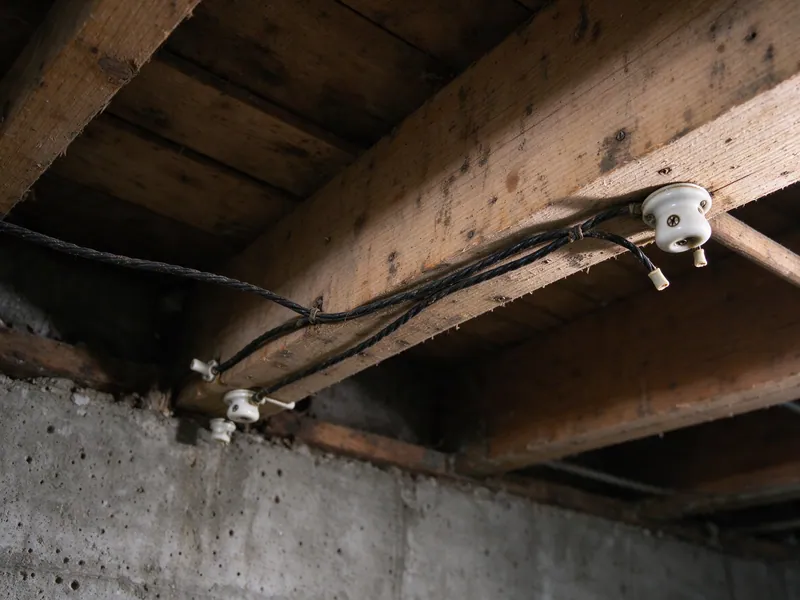
You found porcelain knobs in the attic, or an inspector wrote “knob and tube” in a report, and now you want to know one thing: is it still carrying power? Looking at it won’t tell you. Old wire is in one of three states, active, abandoned or mixed, and only tracing from your fuse box or panel shows which.
At Northloom Minneapolis Knob and Tube, we trace knob and tube in houses across Minneapolis and St. Paul. This guide walks you through the three states, how we confirm each one, and what each answer means for the work your house needs.
Which of the three states is my house in?
Here’s what each state means, and the kind of house it usually turns up in.
| State | What it means for you | Where it usually turns up |
|---|---|---|
| Active | Original circuits still feed your lights and outlets | Houses with little updating since they were built |
| Abandoned | Cut off at the source and left in the walls, dead | Houses an earlier owner fully rewired |
| Mixed | Some original circuits live, some dead, newer wire spliced in | Most houses updated a room or a project at a time |
Most older houses land in the third row. A kitchen gets remodeled, a bathroom gets a new outlet, a fuse box gives way to a breaker panel, and each change touches some circuits and leaves others alone. After a few decades of that, you have a house where the old and new run side by side, and sometimes into each other.
Why can’t I just look and tell?
Because live and dead knob and tube look exactly the same. A dead run doesn’t change color or sag differently from a live one. On top of that, knob and tube runs its hot and neutral wires separately, sometimes in different joist bays and starting from different points, so what you see in one spot is rarely the whole circuit.
- Half a circuit
- The single run you see in your basement may be the neutral of a live circuit whose hot wire runs somewhere else.
- Fed from a splice
- A run cut off at the old fuse box can still be live if a later owner spliced it into a newer circuit.
- Switched off
- A run that tests dead right now may come alive when someone flips a wall switch.
- Hidden length
- Most of any run sits inside finished walls, so you never see its full path.
A non-contact voltage pen can light up near a live wire, but it can’t tell you which circuit it is, whether a switched run is live, or what has been spliced into it. That’s why we don’t stop at a pen.
How do you find out what’s live?
We work from the source outward, and your walls stay closed while we do it.
- We switch each fuse or breaker off in turn and write down every light, outlet and appliance that goes dark.
- We identify the wire leaving each circuit: original knob and tube, cloth-covered cable or modern.
- We follow exposed runs in the attic and basement to see where they start and end, and note every splice to newer wire.
- We test original runs, wire by wire, to confirm which carry power.
- You get a circuit list that marks each circuit live original, dead original or modern.
Most of the visit is switching, looking and testing. Nothing gets opened up to answer the question.
What happens after you know?
The circuit list tells you what kind of job you have, if any.
| What tracing finds | What usually comes next |
|---|---|
| Original circuits feed most rooms | Whole-house rewiring |
| A few original circuits are still live | Partial replacement of those circuits, with the boundary in writing |
| Every original circuit is already dead | Removal and disconnection: we confirm it, pull exposed runs and write the record |
| Original wire spliced into modern circuits | We trace and replace the original sections end to end |
You only need to get this answer once. Your insurer asking whether any knob and tube is energized, a buyer weighing your house, and an insulation contractor deciding whether to start all need the same circuit list.
If it’s dead, do I still have to pull it out?
No. An abandoned run is disconnected and dead but still in your house, and that’s normal. Pulling dead wire out of finished plaster would mean opening every wall it passes through, and you’d gain nothing electrically. What matters is that it’s truly dead and that you can prove it.
- Disconnected at the source
- Not just switched off. We cut it off where it starts, so nothing downstream can be live.
- Tested
- We test each wire along its length.
- Exposed runs
- We often pull these from attics and basements, so the next person doesn’t have to wonder.
- Recorded
- You get, in writing, where each run was disconnected and how we tested it.
The record matters as much as the disconnection. The Center for Energy and Environment notes that electricians often leave deactivated knob and tube in place, and that insulation contractors generally want an electrician’s confirmation before they insulate. The guide to verifying knob and tube is gone explains what a good record holds.
Why does a mixed house take more care?
Because the risk in a mixed house is an assumption. A later owner may have extended an original circuit with newer cable to add an outlet, so the outlet looks modern while its source is original. Or a remodel may have rewired your kitchen but left an original run passing through its walls to feed the dining room.
So we follow each circuit through every change of wire, and your scope replaces whole circuits, not just whatever section happens to be visible. The guide to knob and tube spliced into modern wiring shows where those joins tend to hide.
Are there clues I can check myself?
Yes, a few. They hint at the answer before anyone traces, but none of them proves it.
- Points toward active
- A fuse box still in use, two-prong outlets in bedrooms, ceiling lights on pull chains or push-button switches, and attic runs that lead toward fixtures that work.
- Points toward abandoned
- A modern panel with every circuit labeled, wires visibly cut and capped at the old fuse block, and new cable running beside the old runs to the same rooms.
- Points toward mixed
- Some rooms with grounded three-prong outlets and others without, and newer cable joining old runs in the attic or basement.
Here’s why mixed comes up so often in this city: about 70% of Minneapolis’s one- to three-unit buildings were built by 1939, and most of them have had a kitchen remodeled, outlets added or a panel changed since.
Who else will ask me about this?
Probably more than one person, and each wants the answer in a slightly different shape.
| Who asks | What they want to see |
|---|---|
| Your insurer | A written statement of whether any knob and tube is still energized |
| A buyer | How many circuits are live, and what replacing them would take |
| An insulation contractor | Which attic runs are confirmed dead, and which aren’t |
| Anyone pricing the work | The circuit list, so the price rests on what’s actually there |
| A future owner | The record, with dates, kept with your house papers |
Getting the answer once, in writing, saves you paying to trace the same house twice for different people.
What should I do first?
Whether the question came from an inspection report, your insurer or an insulation crew, the first step is the same: get your circuits traced. Our knob and tube inspection gives you the circuit list and a recommended scope. Questions about your house: (612) 509-6597.