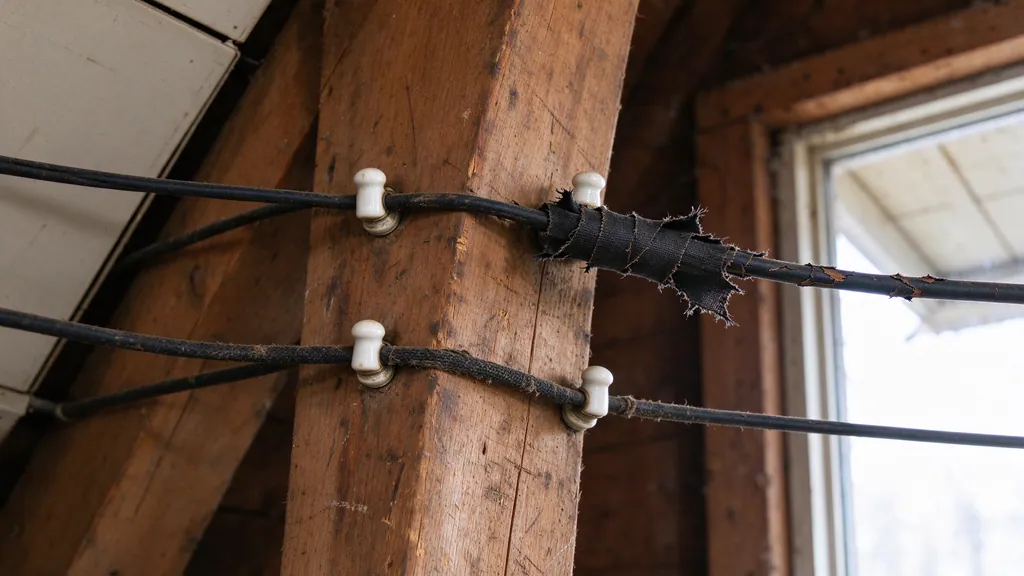
Your kitchen has grounded outlets, the basement shows newer cable, and you assumed the old wiring was gone. Then an inspector or an insurer says there’s still knob and tube in the house. That usually means a circuit runs partly on original wire and partly on later cable, joined somewhere along the way. A modern-looking outlet can depend on century-old wire upstream, and the joins themselves are often where trouble starts.
At Northloom Minneapolis Knob and Tube, we trace and replace mixed circuits across Minneapolis and St. Paul. This guide explains how your house likely ended up this way, where the joins hide, and how we sort it out.
How did my house end up half old, half new?
One owner at a time. About 70% of Minneapolis’s one- to three-unit residential buildings were built by 1939, and almost none has stood still since. Every generation added something, and each addition was tied into whatever wire was nearest.
| When | What changed | How it joined the old wiring |
|---|---|---|
| 1930s to 1950s | Kitchen outlets, a bathroom light, a basement circuit | Cloth-covered cable tied into the nearest original run |
| Later decades | Added outlets, ceiling fans, a finished basement | Modern sheathed cable spliced into whatever circuit was handy |
| Panel swaps | Fuse box replaced with breakers | Original circuits landed unchanged on new breakers |
| Remodels | One room rewired | Original circuits passing through left in place |
None of it came with labels. Most owners don’t know which parts are which, and the previous owner usually didn’t either.
Where are the joins hiding?
In a handful of predictable places. These are where we look first.
- Attics
- Near old ceiling fixtures, where a later owner added a fan or a light and tapped the original run.
- Basement ceilings
- Near where the original fuse box hung, where later circuits started from original ones.
- Behind added outlets
- An outlet added to a wall, fed by a short run of newer cable from an original circuit.
- In walls
- Inside old switch or outlet boxes, where newer cable was joined to original conductors.
- Under insulation
- Splices in attics later buried under blown-in insulation.
Many old splices were twisted, soldered or simply taped, and left hanging in open air instead of inside a box.
Why does a mixed circuit matter if most of it is new?
Because a circuit is only as sound as its oldest piece. These are the problems that follow.
- Hidden age
- An outlet on modern cable can depend on brittle original wire upstream.
- No ground
- The modern section may carry a ground wire with nothing to connect to at the original end, so its three-prong outlets may be ungrounded.
- Weak joins
- Old splices loosen, corrode and break down, especially in attics that swing between hot and cold.
- Misleading looks
- An insurer, a buyer or an electrician who sees modern cable may assume the whole circuit is modern.
- Shared neutrals
- Mixed wiring sometimes shares neutrals between circuits, which can confuse arc-fault protection.
Why does my insurer say I still have knob and tube?
Because in a mixed house, the honest answer to “is any knob and tube still energized” may be yes, even when most of the wiring you can see is modern. Original sections feed parts of modern-looking circuits. A traced record shows exactly where they remain, which is what your agent needs. The homeowners insurance guide covers what carriers ask.
How do you figure out which parts are original?
We work from the panel outward, following each circuit through every change.
- We switch each circuit off at the panel and record everything that goes dark.
- We identify the wire leaving the panel.
- We follow exposed runs in the attic and basement, noting where one kind of wire becomes another.
- We test outlets for grounds, and trace suspicious ones back to their source.
- We record each circuit as modern, original, or mixed, with the location of each change.
The guide to whether knob and tube is still active explains the method in more detail. Our typical range for a knob and tube evaluation is $150 to $500.
How do you fix a mixed circuit?
| What we find | What we do |
|---|---|
| A modern circuit with a short original section | Replace the circuit end to end with grounded cable |
| An original circuit extended with newer cable | Replace the whole circuit, extension included |
| An exposed splice on a circuit that will stay a while | Move the splice into a covered box as an interim repair |
| Several circuits tangled together | Trace them, then replace each one separately so each has its own path |
Replacing only the visible original section, or only the remodeled room, leaves the rest of the circuit as it was. We treat the whole circuit as the unit of work.
Can I spot the signs myself?
Some of them, without touching anything.
- Different cables side by side
- Knob and tube, cloth-jacketed cable and modern sheathed cable all visible on the same basement ceiling.
- Uneven outlets
- Grounded three-prong outlets in remodeled rooms, two-prong or ungrounded ones elsewhere.
- Old fixtures, new switches
- Updated switches and plates on circuits that still feed old ceiling fixtures.
- Taped joins
- Tape-wrapped joins between different-looking wires in the attic or basement.
None of these proves which circuits are which. They’re reasons to have the house traced.
We’re remodeling. Is this the time to deal with it?
Yes. Remodels are where mixed wiring most often turns up, because open walls show original runs passing through. They’re also where it costs least to fix: cable runs without fishing, and connected circuits can be traced and replaced while the walls are open. Our replacement during a remodel service covers how we coordinate with your other trades.
Where does cloth-covered cable fit in?
Mixed houses often include cloth-covered cable from mid-century, which has its own aging problems and usually no ground. We identify it alongside knob and tube and modern cable when we trace. The guide to cloth wiring versus knob and tube explains how to tell them apart.
Do I need the whole house done, or just some circuits?
Mixed houses are the reason partial replacement exists. When tracing shows only a few circuits still include original sections, we replace those circuits end to end without rewiring the house. Our typical range for a partial replacement is $3,000 to $10,000, about $750 to $2,500 a circuit. When original sections run through most circuits, a whole-house rewire makes more sense. The partial versus full guide helps you choose.
I’m buying a house listed as “partly updated.” What should I do?
Get it traced during the inspection contingency. The question isn’t whether the house is mixed, since most older houses are, but how many circuits still include original sections and what replacing them would take. The buying guide covers the timing.
What record do I get at the end?
One that matters more in a mixed house than anywhere else, because the next person to look at your wiring will see a mix too. Your record lists each circuit, whether it was modern, original or mixed, what was replaced, and where original sections were disconnected and how they were tested. If you’d like to talk through your house: (612) 509-6597.