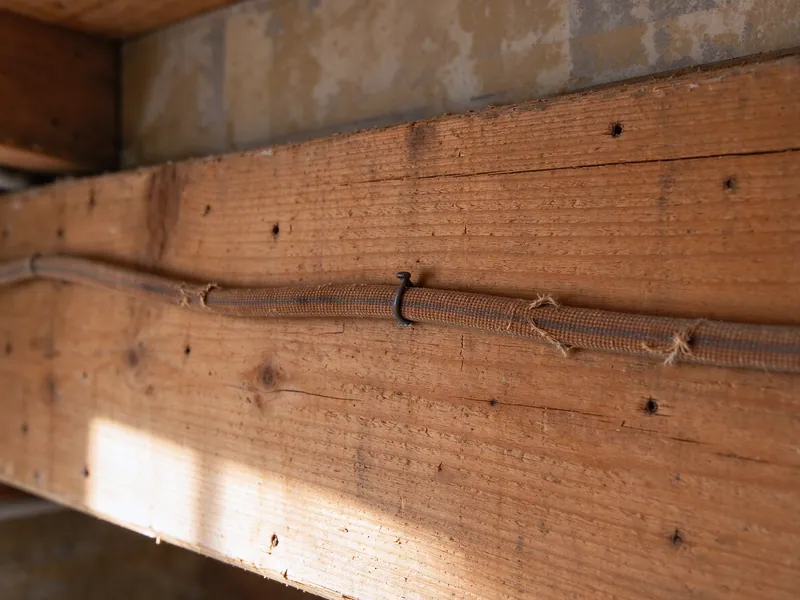
You looked up at the basement ceiling and saw old wire wrapped in cloth, and now you’re not sure whether it’s knob and tube or something else. Here’s the quick test. Knob and tube runs single wires apart from each other on porcelain knobs and through porcelain tubes. Cloth-sheathed cable bundles two wires inside one woven jacket and runs along the framing like modern cable does. Knob and tube came first, cloth cable followed, and plenty of Minneapolis houses have both.
At Northloom Minneapolis Knob and Tube, we replace both across Minneapolis and St. Paul. This guide shows you how to tell them apart, how each one ages, and what that means for your house.
How do I tell which one I have?
Four things give it away, and you can check all of them from a few feet back.
- Look for separation
- Knob and tube’s two wires run apart, often several inches. Cloth cable’s two wires sit together in one round or flat jacket.
- Look for porcelain
- Knobs and tubes mean knob and tube. Cloth cable is held by staples or clamps.
- Look at the boxes
- Cloth cable enters boxes through clamps, like modern cable. Knob and tube wires enter through loom, a woven sleeve over each wire.
- Look at the route
- Knob and tube runs in straight lines between knobs. Cloth cable follows the joists and studs.
Look, don’t touch. Old insulation on either can crumble when it’s handled. The identification guide shows what each part looks like.
How are they different, side by side?
| Knob and tube | Cloth-sheathed cable | |
|---|---|---|
| How it runs | Two single wires, held apart on porcelain knobs and through porcelain tubes | Two wires in one woven jacket, stapled along joists or through drilled holes |
| When it was used | Standard until about 1940 | Common from the 1930s into the 1950s |
| Ground | None | Usually none; some later cable had a small bare ground |
| Insulation | Rubber under a cloth braid on each wire | Rubber on each wire, inside a cloth outer jacket |
| Cooling | Built to shed heat in open air | Bundled, like modern cable |
| Insulation packed around it | Barred in insulated hollow spaces | Not barred in the same way |
Why does my house have both?
Because it was built in one era and updated in the next. About 42.8% of Minneapolis housing units were built in 1939 or earlier, and another 6.0% in the 1940s. A house built in the 1920s with knob and tube often got a kitchen remodel or a few added circuits in the 1940s or 1950s, and those were done in cloth cable. Some houses built in the transition years were wired with both from the start.
How does each one wear out?
Differently, and that’s the main reason the distinction matters.
| What goes wrong | Knob and tube | Cloth cable |
|---|---|---|
| Brittle insulation | Exposed wires crack and flake, worst at fixtures | Insulation inside the jacket cracks where the cable bends and at boxes |
| Wires touching | Unlikely; the wires are apart | Possible where insulation inside the jacket has failed |
| Heat | Trapped when buried in insulation | Builds where cable is bundled or overloaded |
| Splices | Often in open air, taped | Often in old shallow boxes |
| Ground | None | Usually none |
Both carry the same burdens of age: old rubber, no ground, splices, and loads they weren’t sized for.
Can I insulate the attic around either one?
Not around live knob and tube. The electrical code bars concealed knob and tube in hollow spaces filled with insulation around the conductors. Cloth cable doesn’t carry that same specific bar, but old cable buried in insulation still deserves a look before you fill the attic. Insulation contractors generally want any original wiring in the attic confirmed dead or replaced, and a record that identifies each run settles the question.
Are either of them grounded?
Usually not. Three-prong outlets on either one need labeled GFCI protection or a new grounded circuit. Some later cloth cable included a small bare ground wire; testing shows whether it’s actually connected all the way back. The grounding guide explains your options.
Will my insurer or a buyer care which one it is?
It depends on how they ask. Some insurance questionnaires ask specifically about knob and tube. Some ask about “older wiring,” which may include cloth cable. Some ask about both. Home inspectors often note both. A record that names each circuit by type answers whichever question you get.
How do you replace them?
The same way for both. We trace each circuit, replace it end to end with grounded cable, and disconnect the original at its source. Cloth cable often runs through drilled holes along the framing, so its routes can sometimes carry the new cable, which can mean fewer openings in your walls. Because the two are so often spliced together, replacing a circuit usually means replacing both kinds of wire on it.
| What we’d replace | When it fits |
|---|---|
| Cloth-cable circuits only | The knob and tube is already gone and cloth cable remains |
| Both | Most older houses with mixed wiring |
| Priority circuits first | Brittle sections, splices to knob and tube, overloaded circuits |
Our cloth wiring replacement service covers the work, and the guide to what replaces knob and tube explains the new materials. Our typical range for a partial replacement is $3,000 to $10,000, about $750 to $2,500 a circuit.
What about my old light fixtures?
Both systems often end at old fixtures whose own internal wiring has the same aging rubber, baked by decades of bulb heat. Replacing the circuit doesn’t fix the fixture. Fixtures you want to keep can be rewired by a lighting restorer; the rest are replaced.
If I can’t do it all at once, what goes first?
Condition sets the order, not the type of wire.
- First
- Any circuit with crumbling insulation, a buried run, an oversized fuse or a splice hanging in open air.
- Next
- Circuits your insurer, a sale or an insulation project depends on, usually knob and tube in the attic.
- Then
- Bedroom and living-area circuits, where arc-fault protection matters most.
- Later
- Lightly loaded runs in good condition, documented in the meantime.
Replacing whole circuits in that order takes out the biggest risks first and keeps your record clear at every phase.
What’s that metal-jacketed cable?
Probably early armored cable, with a spiral metal jacket, from the same mid-century period as cloth cable. Inside, its wires often have the same aging rubber insulation, and whether the metal jacket gives a reliable ground depends on its type and condition. We identify it along with everything else, and the same rule applies: a circuit is judged by its oldest and weakest section, and replaced end to end when that section is the problem.
What should my record say?
The wire type for every circuit, not just “old wiring.” That lets your insurer answer its own question, whichever wiring it asks about, and tells the next electrician what to expect behind each wall.
So what’s the bottom line?
If you see porcelain, it’s knob and tube. If you see a cloth jacket with two wires inside, it’s cloth cable. If you see both, you’re in good company: that’s most older Minneapolis houses. Either way, tracing tells you what’s live and what each circuit is made of. If you’d like to talk through what you’re seeing: (612) 509-6597.