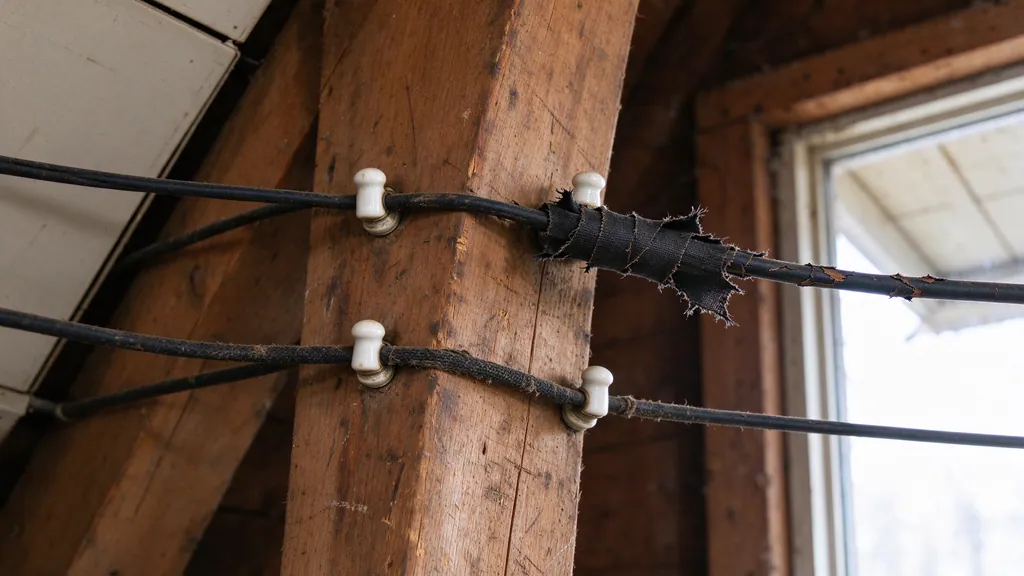
You’ve just learned your house has knob and tube, and the first thing you want to know is whether your family is at risk tonight. Usually not because of the wiring’s age. Put in correctly and left alone, knob and tube was built to run safely, and a lot of it still does. It turns dangerous through what’s happened to it since: insulation laid on top, wire gone brittle, splices hidden in the attic, fuses swapped for bigger ones, damage from later work. Each of those can be found, and each can be fixed.
At Northloom Minneapolis Knob and Tube, we evaluate and replace knob and tube across Minneapolis and St. Paul. This guide shows you how old wiring becomes a hazard, which problems can’t wait, and which limits no repair can remove.
What should I worry about right now?
Heat, smell, sound and scorch marks. Those are the signs that something is wrong today, not someday. If you notice any of them, stop using that outlet, switch or fixture and have the circuit checked.
- Warm covers
- An outlet or switch plate that feels warm when nothing heavy is plugged in.
- Flicker
- Lights that dim or flicker when an appliance starts on the same circuit.
- Frequent fuses
- A fuse that blows again and again. That’s a symptom to look into, not one to silence with a bigger fuse.
- Smell or sound
- A faint burning smell, or buzzing near a fixture, an outlet or the fuse box.
- Discoloration
- Brown or scorched marks around an outlet or switch.
The guide to signs your house needs rewiring covers the quieter warnings, the ones that point to a planned job rather than a call today.
Why did anyone think it was safe in the first place?
Because the design made sense for its time. Knob and tube ran each wire on its own, held off the wood by porcelain, in the open air of hollow walls and attics. Spacing the wires apart and leaving them uncovered let them shed the heat of the current they carried. Porcelain doesn’t burn, and the copper was sound. In a house with a few lights, a radio and nothing piled on the wires, it worked.
That design leans on conditions that rarely hold a century later. Your house has probably been insulated, remodeled and loaded up with appliances its builders never pictured.
How does old wiring turn into a hazard?
Through six things that happen to it over the years.
- Buried in insulation
- Insulation laid over knob and tube traps heat around wires meant to cool in open air. The electrical code bars concealed knob and tube in hollow spaces with loose, rolled or foamed insulation around the conductors.
- Brittle insulation
- The rubber coating dries and cracks with age and heat, worst inside old light fixtures and at switches. Once it crumbles, bare copper is left.
- Hidden splices
- Later owners tied new outlets and fixtures into the original runs, often loose in attics or walls instead of inside boxes.
- Oversized fuses
- A fuse swapped for a bigger one because it kept blowing takes away the protection the wire needs.
- Overloading
- Original circuits were sized for lights and a radio, not space heaters, microwaves and air conditioners.
- Physical damage
- Cracked knobs, sagging wires, and runs nicked by later plumbing, ductwork or rodents.
You can’t see any of these from the living room, and most of them are out of a home inspector’s sight too. That’s why we trace the circuits from the attic and basement instead of judging the house by its outlets.
Which problems can’t wait, and which can?
Not every finding is urgent. Our evaluation sorts them so you know what to fix this week and what to plan for.
| Fix now | Usually fine until a planned replacement |
|---|---|
| Bare copper where the insulation has crumbled | Ungrounded two-prong outlets on sound circuits |
| A fuse much larger than the wire it protects | Original runs in good shape, undisturbed, not overloaded |
| Original runs buried in insulation that feel warm | Dead runs left inside finished walls |
| Scorch marks, buzzing, or a burning smell at an outlet, switch or fixture | A fuse box with correctly sized fuses |
| A loose or hanging splice in the attic or basement | Few outlets per room, used with care |
The urgent items are usually small, contained fixes: putting the right fuse back, repairing a damaged section, freeing a buried run. We handle those first, before anyone settles on the larger scope.
What can’t be fixed without replacing it?
Some of knob and tube’s limits are built into the system. No repair takes them away.
- No ground
- There’s no equipment grounding conductor. A labeled GFCI adds shock protection, but it doesn’t give equipment that needs a ground a real one.
- No arc-fault protection in the original design
- The code now requires arc-fault protection on new circuits in bedrooms, living areas, kitchens, laundry areas and hallways. Fitting it to old two-wire circuits can be unreliable, especially where neutrals are shared or crossed.
- Can't be insulated
- The code bars it in insulated hollow spaces, so the walls and attic around it stay uninsulated while it’s live.
- Can't be freely extended
- New knob and tube is allowed only to extend an existing installation, and every new circuit has to meet the current code.
The AFCI and GFCI guide explains what modern protection can and can’t do on original circuits.
Does plugging in more make it worse?
Yes. Original circuits often fed a whole floor with one or two receptacles a room. Today you run a microwave, a space heater, a window air conditioner and a hair dryer, often through power strips. On a correctly fused circuit, that means nuisance blowing. On an overfused one, it means wire carrying more than it was built for, with nothing to stop it. The guide to knob and tube and modern appliance loads works through the numbers.
Why does my insurer keep asking about it?
Because it looks at the same conditions you do, from farther away. A carrier can’t inspect every house, so many simply ask whether any knob and tube is still energized. A written evaluation that answers that question, and records the urgent conditions that were corrected, gives your agent something to act on. The homeowners insurance guide covers how Minnesota carriers commonly handle it.
Why is the attic such a sore point in Minneapolis?
Because winter makes you want to fill it. With a January normal of 16.2°F in the Twin Cities, the attic is where knob and tube and your comfort run into each other. An uninsulated attic loses heat, and you understandably want it filled. The electrical code bars insulation around live knob and tube, though, and insulation contractors generally won’t go ahead until it’s settled. A run buried in attic insulation usually got there because someone insulated the attic without checking the wiring first.
What should I do this week?
- Don’t cover it with insulation, and don’t let anyone insulate around it.
- Don’t replace a blowing fuse with a bigger one. Unplug whatever is overloading the circuit.
- Watch for heat, smell, buzzing or flicker, and stop using anything that shows them.
- Get your circuits traced, so the urgent conditions are found and the rest can be planned.
Our knob and tube inspection takes care of step four. If you’d like to talk through what you’re seeing: (612) 509-6597.