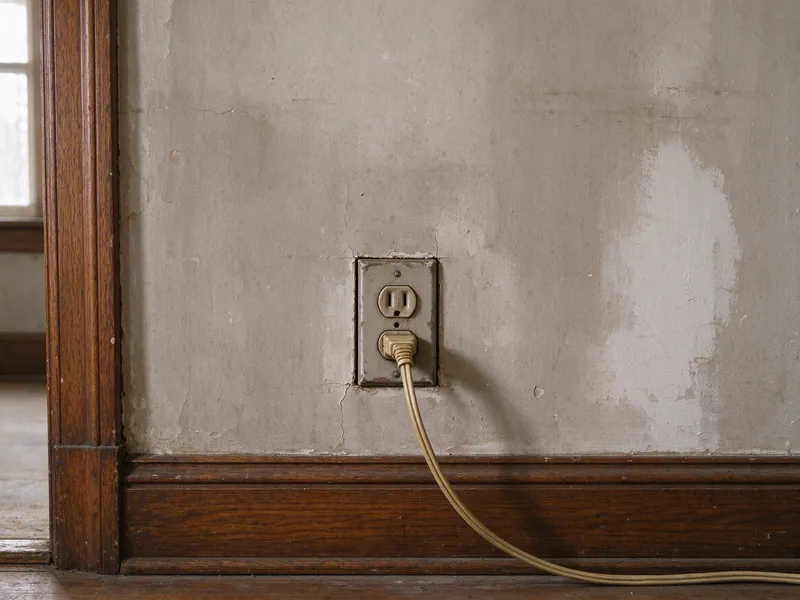
Something in your house doesn’t feel right: an outlet that’s warm to the touch, lights that dip when the microwave starts, a fuse you replace every winter. Or nothing feels wrong, but an inspector or your insurer just put “knob and tube” in writing. Either way, you want to know whether it means rewiring.
At Northloom Minneapolis Knob and Tube, we evaluate and rewire houses in Minneapolis and St. Paul. This guide sorts the signs into three groups: the ones that need attention now, the ones that mean your wiring should be traced, and the ones that show up on paper. Then it explains what we do with them.
Which signs mean I should stop using a circuit?
These. Any one of them is a reason to act today, not to plan.
| Sign | What it can mean | What to do |
|---|---|---|
| Warm outlet or switch cover | A loose connection or overloaded circuit | Stop using it; have it checked |
| Burning smell near a fixture, outlet or the panel | Overheating insulation or a failing connection | Turn off that circuit if safe; have it checked promptly |
| Scorch marks or discoloration | Arcing or overheating | Stop using it; have it checked |
| Buzzing or crackling | A loose connection or arcing | Stop using it; have it checked |
| Sparks when plugging in | A worn outlet or loose connection | Stop using it; have it checked |
| Shocks from a switch, outlet or appliance | A fault, possibly with no ground path | Stop using it; have it checked |
Don’t open boxes or touch the wiring. If you can reach the panel or fuse box safely, turning that circuit off is enough until an electrician gets there.
Which signs mean I should have the wiring traced?
These don’t call for an emergency, but they tell you it’s time to find out what’s behind the walls.
- Two-prong outlets
- Ungrounded circuits, possibly original.
- Ungrounded three-prong outlets
- A plug-in tester shows no ground; the third hole connects to nothing.
- A fuse box
- Original or early equipment; check fuse sizes against the wire.
- Frequent blown fuses or tripped breakers
- Circuits carrying more than they were made for.
- Too few outlets
- Extension cords and power strips doing the wiring’s job.
- Lights dimming
- When a microwave, hair dryer or space heater starts on the same circuit.
- Visible knob and tube
- Pairs of single wires on porcelain knobs in the basement or attic.
- Cloth-covered cable
- Mid-century wiring, usually ungrounded.
None of these alone proves you need a rewire. Several together are a good reason to find out what your house has.
What if someone else noticed it first?
That’s common. Often the first clear sign isn’t something you notice but something someone writes down.
- A home inspection report
- “Knob and tube observed” or “ungrounded outlets”, with a recommendation to have an electrician evaluate.
- A sale report
- In St. Paul, the Truth-in-Sale of Housing report; its sample rates ungrounded three-prong outlets in a kitchen as hazardous.
- An insurer's letter
- A question about knob and tube on an application, or a request to correct it at renewal.
- An insulation bid
- An insulation contractor who won’t proceed until the attic wiring is confirmed dead or replaced.
- A remodel
- Demolition that finds original wiring inside the walls.
Is the age of my house a sign by itself?
It’s a reason to ask, not a verdict. About 70% of Minneapolis’s one- to three-unit residential buildings were built by 1939, and 41.6% of St. Paul’s housing units were. In a house that age, original wiring is likely somewhere unless someone has proven otherwise, and later work is often spliced into it. Age doesn’t mean your house needs rewiring. It means the question is worth answering.
I’m adding air conditioning or a car charger. Does that count?
Yes, your plans can be a sign too. Central air, a heat pump, an induction range, a car charger or a finished basement all put loads on a house that original circuits were never sized for. If we plan the rewire with those loads in mind, together with the panel and service, you avoid doing the work twice. The guide to knob and tube and modern appliance loads explains the numbers.
What looks like a warning sign but might not be?
A few things reassure or worry people for the wrong reasons.
| Observation | Why it may not mean rewiring |
|---|---|
| A breaker panel instead of fuses | The panel may be new while the branch circuits behind it are original, or everything may be modern; only tracing tells |
| Three-prong outlets | They may or may not be grounded |
| A recent remodel | One room rewired doesn’t mean the house was |
| An old house that “has always been fine” | Undisturbed wiring can work for decades; the question is condition and what’s spliced in |
What do you do once I call?
We turn the signs into an answer. An evaluation matches every circuit to its rooms, identifies the wire, tests what’s live, and finds splices, buried runs and oversized fuses. You get a recommended scope: nothing, a few outlets corrected, partial replacement, or a whole-house rewire. Our typical range for a knob and tube evaluation is $150 to $500, depending on the size of the house and how easily we can reach the attic and basement. The partial versus full guide explains how the scope gets chosen.
What should I watch for in a rental?
Listen to your residents. They often notice signs owners don’t, because they live with the circuits every day. Repeated complaints about tripped breakers or blown fuses, outlets that don’t hold plugs, a surge protector’s warning light showing no ground, or lights that dim when a space heater starts are all worth following up. For a landlord, those complaints are also an early warning of what an insurer may ask at renewal.
Can a remodel create new warning signs?
It can. A newly finished room whose outlets trip when used together, a kitchen that runs fine until the microwave and toaster oven run at once, or a bathroom fan that dims the hall lights all suggest new work tied into old circuits. Tracing those circuits shows whether original wiring is feeding your new spaces.
What can I see from the attic and basement?
More than you’d expect, without touching anything. From the attic hatch and the basement stairs, look for pairs of single wires on porcelain knobs, runs half buried in insulation, tape-wrapped joins between different-looking wires, conductors sagging onto wood, or cloth-covered cable stapled beside newer cable. Look, don’t touch, and take photos to show us.
I’m buying an older house. What should I look for on a tour?
You can spot several signs without touching anything: two-prong outlets, a fuse box, power strips everywhere, and knobs visible in the basement. Treat them as reasons to have the circuits traced during the inspection contingency, not reasons to walk away.
What should I have ready when I call?
A short list of what you’ve noticed and where: which outlets are warm or ungrounded, which lights flicker, which fuses blow and when. Note whether you have a panel or a fuse box, and take photos from the basement stairs and the attic hatch. Any reports or letters help too. The guide to identifying knob and tube shows what to look for safely. Questions about your house: (612) 509-6597.