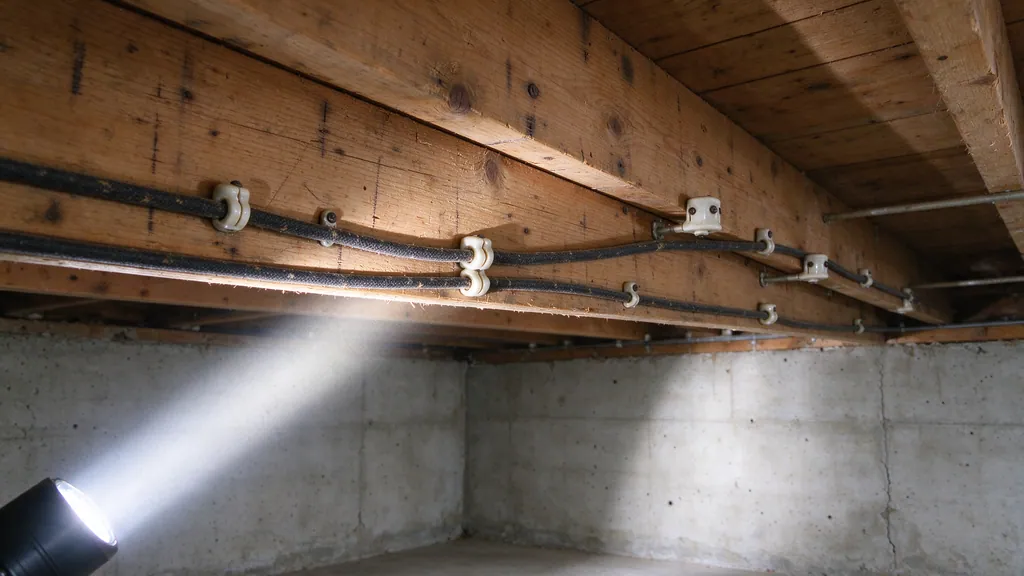
Maybe you saw something odd on the basement ceiling, or your insurer asked a question you couldn’t answer. You can usually spot knob and tube yourself: look for pairs of single wires held apart on white porcelain knobs, or running through porcelain tubes in the joists. Your basement ceiling and attic are the easiest places to see it. What looking can’t tell you is whether it’s still live.
At Northloom Minneapolis Knob and Tube, we trace knob and tube in houses across Minneapolis and St. Paul. This guide shows you what to look for first, safely, and what you can and can’t conclude from what you see.
Is it safe for me to go looking?
Yes, as long as you only look. Old insulation on knob and tube can crack or crumble at a touch, and a run that looks dead may be live. Everything in this guide can be done by eye, from the basement stairs, the attic hatch or across a room.
What exactly am I looking for?
| Part | What it looks like | Where you’ll see it |
|---|---|---|
| Knobs | Small white porcelain spools, about the size of a large thread spool, nailed to wood | Along joists in basements and attics |
| Tubes | White porcelain sleeves set in holes through framing | Where wires pass through joists or studs |
| Wires | Single wires with a dark rubber coating under a cloth braid, running in pairs a few inches apart | Strung between knobs |
| Loom | A flexible woven sleeve over the wires | Where wires enter a box or come close together |
| Splices | Wires twisted together and wrapped in tape, hanging in open air | Along runs, often near fixtures |
The giveaway is separation. Knob and tube runs each wire on its own, held apart from its partner. Cable from later decades bundles two or more wires inside one jacket.
Where in my house should I look?
Most of it is hidden inside finished walls, but the places it still shows are predictable.
- Basement ceiling
- The clearest view in most houses. Look along the joists for pairs of single wires on knobs, especially near where the old fuse box was and under the main first-floor rooms.
- Attic
- From the hatch with a flashlight, look across the ceiling joists of the top floor. Runs often feed ceiling lights below and may be partly buried in insulation.
- Knee-wall spaces
- In a story-and-a-half, the small attics behind the upstairs knee walls often hold original runs to the dormer rooms.
- Closets and stair walls
- Now and then an exposed run or tube shows where a closet ceiling was never finished.
- Old light fixtures
- Inside a ceiling fixture canopy, two single cloth-covered wires instead of a cable can mean original wiring, though only an electrician should open a fixture.
It’s worth checking in this city. About 70% of Minneapolis’s one- to three-unit buildings were built by 1939, when knob and tube was still in use.
Do my fuse box and outlets give anything away?
Some things point toward original wiring without proving it.
| What you notice | What it suggests | Why it isn’t proof |
|---|---|---|
| A screw-in fuse box | Original or early equipment, so original circuits are more likely | Many fuse boxes feed later wiring |
| Two-prong outlets | Ungrounded circuits, possibly original | Cloth-covered cable from later decades was ungrounded too |
| Three-prong outlets | Nothing either way | They’re often swapped onto two-wire circuits |
| Only a few outlets per room, mostly low on the wall | The original layout | Later owners may have kept the layout |
| Push-button light switches | An early installation | They may have been kept on later wiring |
A plug-in outlet tester can show that a three-prong outlet has no ground, which is common on original circuits, but it can’t show what kind of wire is behind it.
Could it be cloth wiring instead?
That’s the most common mix-up. Cloth-covered cable came next, and both have cloth-covered rubber insulation and usually no ground, but they run differently.
- Knob and tube
- Single wires, held apart, on porcelain knobs and through porcelain tubes.
- Cloth-covered cable
- Two wires bundled in one woven jacket, stapled flat along joists or run through drilled holes, like modern cable.
- Often both
- A house built in the 1920s and updated in the 1940s may have both, sometimes spliced together.
The guide to cloth wiring versus knob and tube shows you how to tell them apart.
What can’t I tell just by looking?
Spotting it answers only the first question. Your insurer, a buyer or an insulation contractor will ask the next ones.
| What they’ll ask | Why looking can’t answer it |
|---|---|
| Is it live? | Live and dead runs look the same, and hot and neutral may travel separately |
| How much of the house does it feed? | Most runs are inside finished walls |
| What’s been spliced into it? | Joints are often in walls or under insulation |
| Is any of it buried in insulation? | You only see part of the attic from the hatch |
A non-contact voltage tester doesn’t settle it either. It can light up near a live wire without telling you which circuit it is, and miss a run that’s live but switched off. The guide to whether knob and tube is still active explains how we trace.
Why did my home inspector just say “observed”?
A home inspection usually notes knob and tube when the inspector sees it in the basement or attic, sometimes alongside ungrounded outlets found with a plug-in tester. The report is a visual survey of the whole house, so it typically says the wiring was “observed” and recommends evaluation by a licensed electrician. That’s the inspector telling you the same thing this guide does: you can see that it’s there, but not how much there is or whether it’s live.
I’ve found it. Now what?
Write down where you saw it and take photos from where you stood. Note whether you have a fuse box or a panel, and any two-prong or ungrounded outlets. Then:
- Don’t cover it with insulation, and don’t let anyone insulate around it yet.
- Don’t answer a blowing fuse with a bigger one.
- Get the circuits traced, so you know what’s live, what’s dead and what’s spliced in.
Our knob and tube inspection gives you the circuit list every later decision depends on, and the complete guide to knob and tube wiring explains the whole system. Questions about your house: (612) 509-6597.