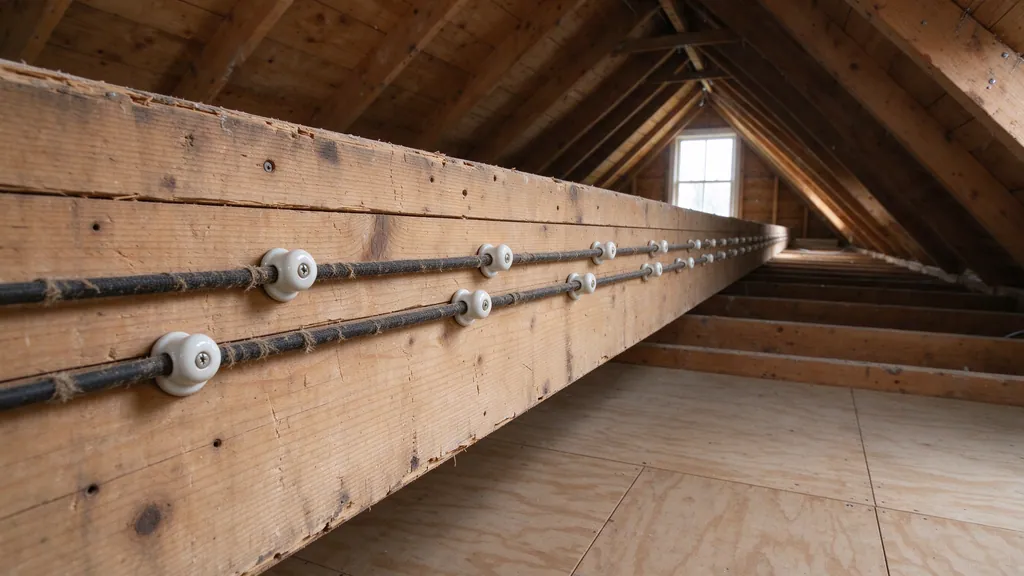
Maybe an inspection report said “knob and tube present.” Maybe your insurer sent a letter, or the insulation contractor stopped at the attic hatch and wouldn’t go further. Either way, you’re now holding a question about wiring you’ve never seen and can’t easily judge. Knob and tube is how most Minneapolis houses were wired before about 1940: two separate wires, one hot and one neutral, run through the framing on porcelain, with no ground. Plenty of it is still in place here. Whether yours needs replacing depends on how much is still live, what’s been spliced into it, and who is asking.
At Northloom Minneapolis Knob and Tube, we trace and replace knob and tube across Minneapolis and St. Paul. This guide explains the system from the porcelain up, so that an inspection report, an insurer’s letter or a rewiring quote reads as something you can judge for yourself.
What is actually in my walls?
A way of running wires, not a single product. Each circuit uses two single wires, a hot and a neutral, and they travel through your house separately.
- Knobs
- Porcelain spools nailed to joists and studs. Each wire wraps around its own row of knobs, which hold it a few inches off the wood and away from its partner.
- Tubes
- Porcelain sleeves set in holes bored through joists and studs, so a wire can pass through the framing without touching it.
- Loom
- A flexible woven sleeve slid over the wires where they come close together or enter a box, a light fixture or a switch.
- The wire
- Copper with a rubber coating under a cloth braid. Joints were twisted, soldered and wrapped in tape where they hung in open air.
Because the hot and the neutral run apart, sometimes in different joist bays, one circuit can wander across your basement ceiling or attic in two separate paths. That’s part of why it’s hard to read by eye, and why a run that looks abandoned can still be half of a live circuit.
The whole design depended on air. Spacing the wires out and leaving them uncovered in hollow walls and ceilings let them shed the heat of the current they carried. It works as intended only as long as nothing covers them.
Why do so many Minneapolis houses still have it?
Because the city grew fast in the decades when knob and tube was the standard, and much of that housing still stands.
| Measure | Figure | Source |
|---|---|---|
| Minneapolis housing units built 1939 or earlier | 89,537 of 209,080 (42.8%) | U.S. Census Bureau, American Community Survey |
| Built in the 1940s | Another 6.0% | U.S. Census Bureau |
| One- to three-unit residential buildings built by 1939 | 60,742 of 86,818 (70.0%) | City of Minneapolis property records |
| St. Paul housing units built 1939 or earlier | 55,312 of 133,051 (41.6%) | U.S. Census Bureau |
The share runs higher still in the older communities. City property records put buildings of one to three units built by 1939 at 89.1% in Powderhorn, 85.2% in Longfellow, 83.8% in Phillips, 80.8% around the University and 80.0% in Uptown.
A house that old hasn’t stood still. Most have had a kitchen remodeled, outlets added, a fuse box swapped for breakers and an attic insulated, each by a different owner. So your house is rarely all knob and tube or none of it. It’s usually a mix, and the mix is what an evaluation has to untangle.
Where does it run in a house like mine?
Where knob and tube hides, and how we replace it, follows the shape of your house more than its age.
- Houses under two stories
- Most homes in Longfellow, Nokomis and Camden are under two stories: only 16.1%, 16.3% and 10.3% of their one- to three-unit buildings have two or more. Original runs tend to sit in the attic knee walls and the basement ceiling, both reachable without opening many walls.
- Two- and three-story houses
- In Uptown, 74.3% of these buildings have two or more stories, and in Southwest 47.4%. Second-floor wiring has to cross a finished floor, so closets and stacked walls become the routes.
- Duplexes and triplexes
- The city counts 10,592 duplex and 963 triplex parcels. Each unit usually has its own circuits, and sometimes its own panel and meter.
- Radiators or ducts
- About 66% of pre-1940 houses in Uptown and 61% in Southwest heat with hot water, against 74% forced air in Longfellow. Forced-air houses have duct chases that cable can sometimes share; a house with radiators has fewer ready-made paths between floors.
How did houses come to be wired this way?
Electric light reached Minneapolis houses in the 1880s and 1890s, and for the next half century knob and tube was how they were wired. The method suited its time. Copper was costly, so single wires were used sparingly. Porcelain was cheap and didn’t burn. Leaving the wires in open air was the simplest way to keep them cool.
The National Electrical Code, first published in 1897, set the rules for spacing, supports and the loom that protected wires at boxes. Through the 1920s and 1930s, cable with two insulated wires in one cloth jacket took over, because it went in faster and could run along the framing. By about 1940, knob and tube was rarely used in new houses, though electricians kept extending existing circuits for decades. That long tail is why an original circuit in your house can carry a 1950s kitchen outlet or a 1970s attic fan.
Was it ever any good?
Yes. It was a reasonable system for the houses and loads it was built for, and its basic parts last. Its limits are about how you live now.
- Strengths
- Copper wire, porcelain that doesn’t rot or burn, and open-air spacing that kept the wire cool. Undisturbed runs in a dry attic can still look much as they did the day they went in.
- No ground
- There’s no equipment grounding conductor. A three-prong outlet on a knob and tube circuit has nothing behind its third hole unless something else was done.
- Few, small circuits
- A whole floor often ran on one circuit with one or two receptacles a room, sized for lights and a radio, not a microwave, a space heater and a hair dryer.
- No modern protection
- Arc-fault and ground-fault protection, which the code now requires on new circuits in most rooms, arrived long after this wiring went in.
None of that makes a given run dangerous on its own. It does mean the system wasn’t built for how you use your house today, and it can’t be brought up to today’s rules without replacing it.
What actually goes wrong with it?
Most trouble comes from what’s happened to the wiring since, not from the original job. These are the failures we look for when we evaluate a house.
Why does the insulation on the wire crumble?
The rubber coating dries out with age and heat, and the cloth braid over it frays. The worst of it tends to be at the ends of runs: inside old light fixtures, where bulbs heated the wire for decades, and at switches and outlets that have been handled. Insulation that crumbles at a touch leaves bare copper a few inches from the next wire.
What happens when it’s buried in insulation?
Blown-in or rolled insulation laid over knob and tube takes away the open air the system needs to shed heat. The electrical code bars concealed knob and tube in hollow spaces filled with loose, rolled or foamed insulation that surrounds the conductors. Attics are where this shows up most, often from an energy upgrade done before anyone checked the wiring.
Where do the hidden splices come from?
Every later owner who tied a new outlet, a fixture or a run of cable into an original circuit added a joint. Some are in boxes. Many aren’t: they sit in the attic near an old ceiling fixture, in the basement near where the fuse box used to hang, or behind an outlet added to a wall. A hidden splice between old rubber-covered wire and newer cable is one of the most common things an evaluation turns up.
Why is a bigger fuse such a problem?
Original circuits were usually protected by 15-amp fuses. When a fuse kept blowing, a common fix was a bigger one. That stops the nuisance and removes the protection: the wire can then carry more current than it was made for, with nothing to stop it. Space heaters, window air conditioners and kitchen appliances on one old circuit are the usual reason the fuse was blowing in the first place.
What else damages it?
Knobs crack or come loose, wires sag onto wood or onto each other, and later plumbing, ductwork or remodeling nicks or pulls runs that were in the way. Rodents chew exposed wires in attics and basements.
The guide to whether knob and tube is dangerous separates the conditions that need attention now from the ones that can wait for a planned replacement.
How can I tell if my house has it?
You can often spot it without touching anything. Look, don’t handle: old insulation can break at a touch, and a run that looks dead may be live.
- Basement ceiling
- Pairs of single wires on white porcelain knobs along the joists, or passing through porcelain tubes in them, are the clearest sign.
- Attic
- The same runs across the ceiling joists, sometimes half hidden in insulation. A flashlight from the hatch is enough; you don’t need to walk the attic.
- Fuse box
- Screw-in fuses aren’t proof, but an original fuse panel makes original circuits more likely.
- Outlets
- Two-prong outlets suggest ungrounded wiring. A three-prong outlet proves nothing, since it may have been swapped onto a two-wire circuit.
What you can’t tell by looking is how much is still connected and where it goes. A house with no visible knob and tube in the basement can still run its second floor on it, and a basement full of knobs can be entirely disconnected. The identification guide has photos of each part and the places it hides.
Is mine still live, or just left in the walls?
That’s the most useful thing you can know about your knob and tube, and it’s always one of three answers.
| State | What it means | What usually follows |
|---|---|---|
| Active | Original circuits still carry power to lights and outlets | Replacing those circuits, partial or whole-house |
| Abandoned | Disconnected at its source and left in place, dead | Confirmation and a written record; removal of exposed runs if you want it |
| Mixed | Some original circuits live, some dead, with newer wiring spliced into both | Tracing every circuit before any price is set |
Mixed is the common case in Minneapolis. Tracing means identifying each circuit at the fuse box or panel, following it to the rooms it serves and testing what’s energized. That’s why “knob and tube present” on an inspection report is a starting point, not an answer. The active versus abandoned guide explains how each state is confirmed.
What happens during an evaluation?
We turn “knob and tube present” into a list you can act on. It’s mostly looking and testing, not opening walls.
- At the panel
- Each fuse or breaker is matched to the rooms and devices it feeds, and the wire leaving it is identified as original, cloth-covered or modern.
- In the rooms
- Outlets, switches and fixtures are checked against the circuit they belong to, and three-prong outlets are tested for a real ground.
- Attic and basement
- Exposed runs are followed as far as they can be seen, splices are noted, and any insulation over wiring is recorded.
- What you get
- A circuit list marking each one live original, dead original or modern, with the splices and conditions that need attention and the scope that follows.
That list is what an insurer, a buyer’s agent or an insulation contractor can read, and it’s the only sound basis for a replacement price. Our knob and tube inspection is the same survey offered on its own, and our typical range for it is $150 to $500.
Am I breaking the law by keeping it?
No. Existing knob and tube isn’t unlawful in Minnesota just because it’s old. Minnesota adopts the National Electrical Code without amendment, and that code still has an article for concealed knob and tube. It limits the system in three ways that matter to you:
- New knob and tube is allowed only to extend an existing installation, or elsewhere with special permission.
- It can’t be used in hollow walls, ceilings or attics filled with loose, rolled or foamed insulation that surrounds the conductors.
- Every new circuit has to meet the current code, with a ground and the protection the code requires.
The question that actually decides things is usually insurance, a sale or insulation, and each of those can set a stricter standard than the code. The Minnesota legality guide covers the code in more detail.
Will I be able to insure the house?
Usually, though it may take some work. Many carriers ask on the application whether any knob and tube is still energized, and some won’t write a new policy until it’s replaced or shown to be disconnected. Policies already in force follow Minnesota’s rules on nonrenewal.
- Two written requests
- A Minnesota insurer can nonrenew over a known condition it wants fixed only after asking in writing twice, naming the condition and why it raises the risk of loss. The first request sets the time limits; the second states the intent to nonrenew.
- The FAIR plan
- Minnesota’s FAIR plan insures property the regular market declines. It may inspect, and it can accept a house only once improvements it lists are made.
- What helps
- A written record of what was replaced, what was disconnected and how it was tested. Your agent can act on that; “some of it was updated” isn’t much to go on.
The homeowners insurance guide and the guide to insurer deadlines go through what to send and when.
What happens when I buy or sell?
Knob and tube comes up most often at a sale, because that’s when a house gets inspected end to end.
- St. Paul
- Before listing, a City-licensed evaluator prepares a Truth-in-Sale of Housing report for buyers. It’s disclosure: the only repair it requires is a hard-wired smoke alarm. The city’s sample report rates ungrounded three-prong outlets in a kitchen as a hazardous condition.
- Minneapolis
- Minneapolis has its own Truth in Sale of Housing evaluation. How it treats original wiring is confirmed with the evaluator for each house.
- If you're buying
- A home inspector can say knob and tube is present but usually can’t say how much is live. Whether you can insure the house is the question to settle before your inspection contingency ends.
- If you're selling
- Replace it, document what’s disconnected, or price it in. A recent circuit record answers most buyer questions before they reach the negotiation.
The buying guide and selling guide cover each side.
Why won’t anyone insulate my attic?
Because knob and tube and attic insulation don’t mix, and in a Minnesota winter that conflict is often what brings the wiring to light.
- The rule
- A 1987 change to the electrical code barred insulation in contact with knob and tube, and the code still bars it today.
- Insulation contractors
- The Center for Energy and Environment notes that insulation contractors generally won’t insulate around active knob and tube, and most want an electrician to confirm it’s inactive first.
- The paperwork
- Keep the electrical invoice or record. Your insulation contractor and your insurer will both want to see it.
- The rebate
- Xcel Energy pays 40% of qualifying attic or wall insulation, up to $1,200 each, for customers who heat with Xcel gas or electricity, with air sealing required.
Our attic insulation service explains how we settle the wiring before the insulation goes in.
Can I just put in three-prong outlets?
Not by swapping the outlet alone. A knob and tube circuit has no ground wire, so there’s nothing to connect a third prong to. The code gives you three ways to replace an outlet on an ungrounded circuit:
| Option | What it does | Label required |
|---|---|---|
| Two-prong outlet | Matches the circuit honestly | None |
| Ground-fault (GFCI) outlet | Adds shock protection without a ground | “No Equipment Ground” |
| Three-prong outlet protected by a GFCI | Takes three-prong plugs, with shock protection | “GFCI Protected” and “No Equipment Ground” |
A GFCI protects people from shock. It doesn’t give surge protectors or equipment that needs a ground a real one, which is why the lasting fix is a new grounded circuit back to the panel. The grounding guide explains each choice.
How do you replace it?
We start from the traced circuit list. How much is live sets the scope.
| Scope | Fits when | What happens |
|---|---|---|
| Whole-house rewiring | Original circuits still feed most rooms | Every branch circuit replaced with grounded cable, old circuits disconnected |
| Partial replacement | A few original circuits remain in an otherwise updated house | Only the live original circuits replaced, with a written boundary |
| Removal | The old wiring is already dead | Confirmed disconnected, exposed runs pulled, record written |
New cable runs through the hollow spaces your house already has: down from the attic, up from the basement and through closets between floors. Walls open where framing blocks the cable or where a new box goes. Concealed runs inside finished walls are usually disconnected and left in place, dead, because pulling them out would mean opening every wall they pass through.
Do I need a permit, and who inspects?
Yes. A rewire needs a permit and two inspections, and who handles them depends on which side of the city line you’re on. Getting the permit in place is part of the job.
- Minneapolis
- The Minnesota Department of Labor and Industry issues the permit and inspects. A typical rewire of 15 to 30 circuits in a one-family home carries a $191 state fee.
- St. Paul
- The City’s Department of Safety and Inspections runs its own electrical inspection, at $15 a circuit.
- Suburbs
- The state, or one of about 66 Minnesota cities with their own electrical inspection.
- Inspections
- The request is filed at or before the start of work. A rough-in inspection comes before any wiring is covered, and a final follows when the work is done.
The permit guide walks through the sequence.
What will it cost me?
Our typical range for a whole-house knob and tube replacement is $12,000 to $36,600, about $8 to $20 per square foot, before panel work and wall finishing. Your circuit count, the access, the plaster, the panel and the number of units move your house within that range. For smaller jobs, our typical range for a partial replacement is $3,000 to $10,000, and for a panel and service upgrade $2,500 to $7,000. The Minneapolis cost guide breaks a price into its parts.
Can we stay in the house while it’s done?
Most families do. The work moves room by room or floor by floor, with power off to each area while its circuits are switched over, and the Center for Energy and Environment tells homeowners to expect outages during replacement. In a Twin Cities winter, with a January normal of 16.2°F, your furnace stays on a working circuit through every stage.
Expect the rooms being worked on to be off limits for part of a day, with furniture moved away from the walls that will be opened and floors covered. The refrigerator, the furnace and a few lights usually stay on a working circuit, even if that means a temporary cord from a finished circuit for a day. Openings are closed or protected at the end of each day, and dust stays in the room where the work is happening. The guide to living at home during a rewire covers dust, outages and what each stage feels like.
What should I ask before I hire anyone?
Rewiring a lived-in house well is as much planning as wiring. These questions separate a careful scope from a quick one, whoever you’re talking to.
- License
- Minnesota licenses electrical contractors through the Department of Labor and Industry, and you can look up a license on DLI’s website before you sign.
- Tracing
- Ask how the circuit count in the quote was found. A count from tracing at the panel is a basis for a price; a count from walking the rooms is an estimate.
- Openings and patching
- Ask how many openings to expect, where, and who closes them to what finish.
- Permit
- Ask how the request for inspection is handled and whether the rough-in and final are in the price.
- The record
- Ask what you get at the end: a circuit list, a panel directory, and a written statement of what was disconnected and how it was tested.
The hiring guide and the quote comparison guide go further.
Does old wiring raise my energy bills?
Not directly. Knob and tube doesn’t waste electricity in itself: a circuit carries what the lights and appliances draw. The cost shows up elsewhere. An attic that can’t be insulated loses heat all winter, and power strips and extension cords fill in for outlets the house never had. Replacing the wiring is what lets your attic be insulated and air sealed, which is where the energy savings come from, and with Xcel’s rebate it’s also where some of the money comes back.
I’ve found knob and tube. What do I do now?
Whether you spotted it yourself or a report told you, the order of steps is the same for most houses:
- Don’t disturb it, and don’t cover it with insulation.
- Don’t answer a blowing fuse with a bigger one. Unplug what’s overloading the circuit and have it checked.
- Get your circuits traced, so you know what’s live, what’s dead and what’s spliced in.
- Decide the scope from that list: whole-house, partial or removal.
- Keep the written record. Your insurer, a buyer and your insulation contractor will all ask for it.
If an insurer or a sale has given you a deadline, start with our knob and tube inspection. It produces the circuit list every other decision depends on. If you’d like to talk through your house: (612) 509-6597.