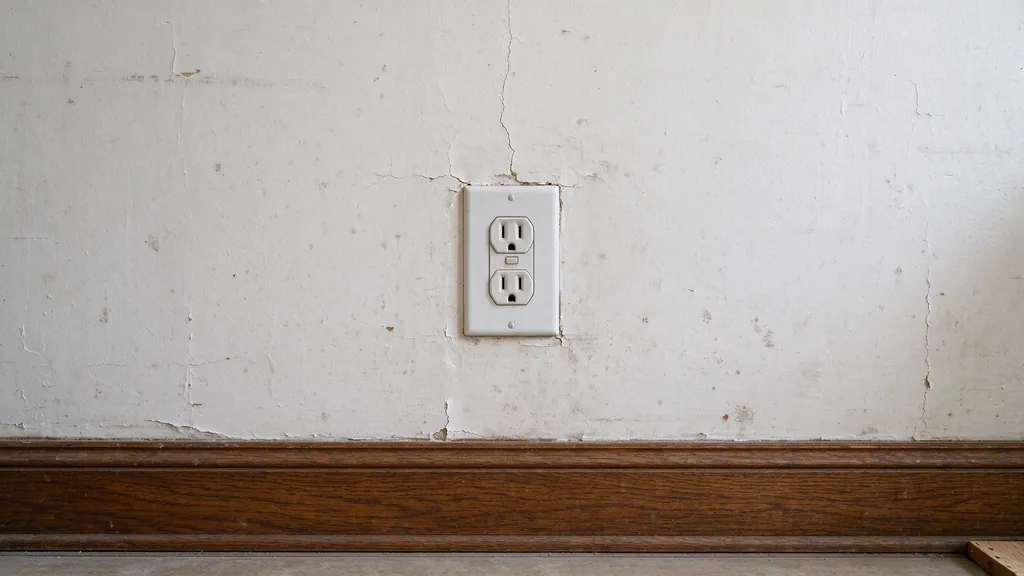
You plugged a tester or a surge protector into a three-prong outlet and it told you there’s no ground. Or your inspector wrote “ungrounded outlets” on the report. You want to know if the old wiring can be grounded. Not the way modern wiring is: knob and tube has a hot and a neutral and nothing else, and there’s no way to give the original circuit a ground.
At Northloom Minneapolis Knob and Tube, we correct ungrounded outlets and replace original circuits in Minneapolis and St. Paul. This guide explains what a ground does for you, the three honest fixes the code allows, and when we’d tell you to skip them and run a new circuit.
What does the ground actually do for me?
It gives a fault somewhere safe to go. A grounded outlet has three connections: hot, neutral and equipment ground. The ground ties the metal parts of your appliances, and the round hole in the outlet, back to the panel.
- Fault protection
- If a hot wire touches a metal appliance case, the ground carries the fault current back so the breaker trips, instead of leaving the case energized.
- Surge protection
- Surge protectors divert voltage spikes to the ground.
- Electronics
- Some equipment relies on the ground for noise filtering and safe operation.
Knob and tube went in before homes were required to have equipment grounds. There’s simply no third wire to connect to.
Why does my house have three-prong outlets with no ground?
Because someone wanted modern plugs to fit. Over the decades, a lot of two-prong outlets on knob and tube were swapped for three-prong ones. The third hole connects to nothing, and anyone plugging in a grounded appliance or a surge protector assumes a ground that isn’t there.
St. Paul’s sample Truth-in-Sale of Housing report rates ungrounded three-prong outlets in a kitchen as a hazardous condition.
What are my options for fixing an ungrounded outlet?
Three, all allowed by the code where no ground exists in the box.
| Fix | What is installed | Label | What it gives you |
|---|---|---|---|
| Two-prong | A non-grounding receptacle | None | An honest match for the circuit |
| GFCI receptacle | A GFCI-type receptacle | “No Equipment Ground” | Shock protection, accepts three-prong plugs |
| Protected three-prong | A grounding-type receptacle fed through a GFCI | “GFCI Protected” and “No Equipment Ground” | Shock protection, accepts three-prong plugs |
On an ungrounded circuit, no ground may be connected between outlets downstream of a GFCI, because there’s no true ground to connect. The labels tell the next person, whether that’s you, a buyer’s inspector or an electrician, exactly what they’re looking at.
Isn’t a GFCI just as good as a ground?
For shock, it’s very good. For your electronics, it isn’t. A GFCI compares the current going out on the hot with the current coming back on the neutral. If some leaks elsewhere, through a person, for example, it cuts power in a fraction of a second, and it doesn’t need a ground wire to do that.
- It does
- Protect people from shock at that outlet and those downstream.
- It doesn't
- Give a surge protector, computer or appliance the equipment ground it relies on.
- It doesn't
- Fix the circuit’s age, brittle insulation or hidden splices.
So a labeled GFCI is a real improvement for many outlets, and not enough for some.
When do I need a new circuit instead?
When the outlet’s job needs a true ground, or the circuit behind it is original from end to end.
| Situation | Why a new circuit |
|---|---|
| Kitchen counters | The code requires dedicated 20-amp small-appliance circuits there anyway |
| Home office or media wall | Surge protectors and electronics need a true ground |
| Bathroom | A 20-amp circuit with ground-fault protection |
| Laundry | A metal washer needs a grounded, protected circuit |
| The circuit is original knob and tube throughout | Replacing it solves every outlet on it at once |
We run grounded cable from the panel to the outlets, with arc-fault and ground-fault protection where the code lists it. The guide to what replaces knob and tube explains the materials.
Can’t you just add a ground wire to one outlet?
The code does allow an equipment grounding conductor to be run separately to an existing outlet from certain approved points. On knob and tube, it’s rarely worth it. The rest of the circuit stays original and ungrounded, the new ground wire needs its own route through finished walls, and the effort comes close to running a whole new circuit. In most cases we’ll recommend the new circuit instead, and explain why for your outlet.
Why are there so few outlets in my old house?
Because the original wiring often gave a room one or two receptacles, sometimes on a baseboard, sometimes none at all where a ceiling fixture had a plug-in socket. Owners filled the gaps with extension cords and power strips, many plugged into those same few ungrounded outlets. That’s the other reason grounding questions lead to new circuits: a rewire can put grounded receptacles where your furniture and appliances actually sit, so cords and strips stop doing the wiring’s job.
Will buyers, residents or my insurer notice?
Usually, yes. Ungrounded three-prong outlets are among the first things a buyer’s inspector checks with a plug-in tester, and one of the items sale reports most often list. Landlords hear about them from residents who plug in a surge protector and see a warning light. Correcting them, with labeled GFCI protection or new grounded circuits, and keeping a list of what was done, answers all three at once.
How can I check my own outlets?
With a plug-in outlet tester from the hardware store. It shows whether a three-prong outlet has a ground. It can be fooled by a bootleg ground, and it can’t tell you what wire is behind the outlet, but it’s a useful first look. Plug it in; don’t open outlets or touch wiring. When we evaluate a house, we test every outlet properly and trace each one to its circuit. Our typical range for a knob and tube evaluation is $150 to $500.
How do you decide what each outlet gets?
We treat each one on its own merits.
- Test every three-prong outlet for a real ground and for a bootleg ground.
- Trace each ungrounded outlet to its circuit, and identify the wire.
- Where the circuit is sound and the use is light, use a two-prong or a labeled GFCI.
- Where equipment needs a ground, or the circuit is original knob and tube, run a new circuit.
- Record each outlet and what was done.
Ungrounded outlet upgrades covers how we do the work, and the AFCI and GFCI guide explains where each kind of protection applies. Questions about your house: (612) 509-6597.