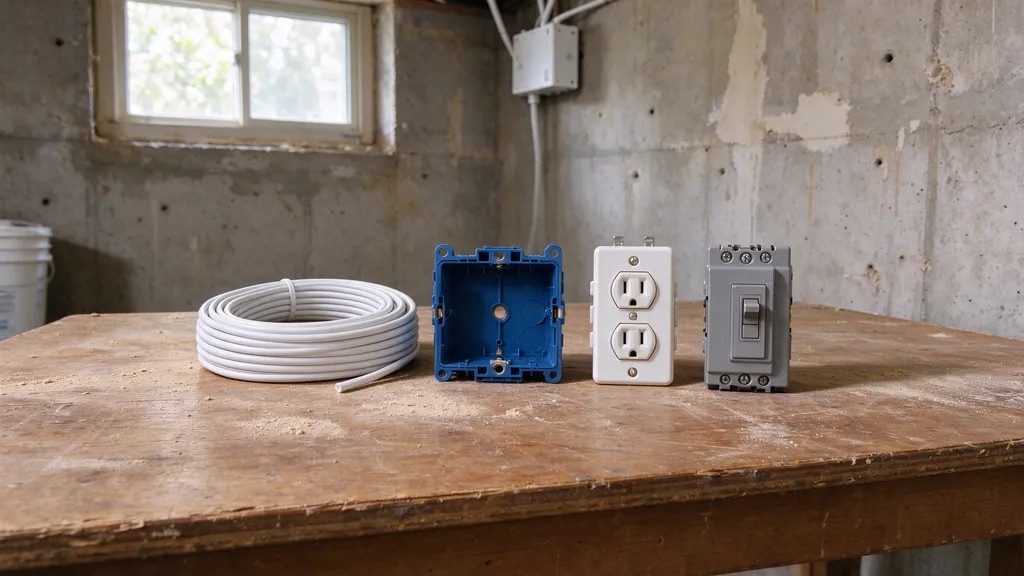
You know the knob and tube has to go, and you want to picture what goes in its place before anyone opens a wall. The short answer is grounded cable, the standard house wiring today, fished through your existing walls from the attic and basement. The longer answer is a new set of circuits, each with the right wire, the right box and the right protection, laid out for how you use the house now.
At Northloom Minneapolis Knob and Tube, we replace knob and tube in Minneapolis and St. Paul. This guide walks you through each part of what goes in, so you can read a scope and know what you’re getting.
How is the new wiring different from what I have?
In almost every way that matters for safety and for daily use.
| Knob and tube | Replacement wiring | |
|---|---|---|
| Conductors | Two single wires, run apart | Hot, neutral and bare ground together in one jacket |
| Insulation | Rubber under cloth braid | Modern thermoplastic insulation, plastic outer jacket |
| Ground | None | Bare equipment ground to every box and device |
| Support | Porcelain knobs and tubes | Stapled to framing, through drilled holes |
| Boxes | Shallow or none | Sized for the cable and devices |
| Protection | Fuses | Breakers, with arc-fault and ground-fault protection where listed |
| Insulation around it | Barred | Allowed |
That last row is the one many Minneapolis owners care about most: once the old wiring is out of service, the attic can finally be insulated.
What kind of cable goes in?
Nonmetallic sheathed cable, often called by the brand name Romex. It bundles insulated hot and neutral conductors with a bare copper ground inside one plastic jacket. We fish it through hollow wall cavities, staple it to framing where it’s exposed in the attic and basement, and run it through holes drilled in the framing.
- 15-amp circuits
- 14-gauge copper, for general lighting and outlets.
- 20-amp circuits
- 12-gauge copper, for kitchen counters, bathrooms, laundry and some general circuits.
- Larger loads
- Heavier cable for ranges, dryers, water heaters and car chargers, sized to the appliance.
- Other methods
- Conduit or armored cable where exposed or where the code calls for it.
Why do the boxes have to change?
Because your original boxes were made for two single wires and often for shallow devices. Modern cable and devices, especially GFCI and dual-function receptacles, need more room.
- Old-work boxes
- Designed to be set in finished plaster through a small opening, clamping to the wall.
- Sizing
- Boxes sized for the number of conductors and the device.
- Original locations
- Reused when they fit, which saves an opening.
What protection do the new circuits get?
The protection the code lists for each room. On new circuits, Minnesota enforces the National Electrical Code without amendment.
| Protection | Where |
|---|---|
| Arc-fault | Bedrooms, living rooms, family and dining rooms, dens, kitchens, laundry areas, hallways, closets and similar rooms |
| Ground-fault | Kitchens, bathrooms, basements, garages, laundry areas, crawl spaces and outdoors |
| Both | Kitchens and laundry areas, often from dual-function devices |
Most of that protection lives at the panel, so the panel needs room for it. The AFCI and GFCI guide explains what each kind does.
Will my circuits be laid out differently?
Yes. A rewire redraws the circuits, not just the wire.
- Kitchen
- At least two 20-amp small-appliance circuits for the counters, plus dedicated circuits for appliances that need them.
- Bathroom
- A 20-amp circuit for the receptacles with ground-fault protection.
- Laundry
- Its own 20-amp circuit.
- Bedrooms and living areas
- Outlets where furniture and electronics actually sit, with arc-fault protection.
- Lighting
- Ceiling fixtures reconnected on new circuits, with switches where people expect them.
Original wiring often gave a room one or two outlets. The new layout ends your reliance on extension cords and power strips.
Will I need a new panel?
Usually the rewire ends at a breaker panel with room for the new circuits and their protection. Whether your service also needs to be larger comes from a load calculation of what the house will run, including any planned air conditioning, heat pump, induction range or car charger. Our typical range for a panel and service upgrade, 100 to 200 amps, is $2,500 to $7,000. The panel upgrade guide explains how the panel and the rewire fit together.
What about outlets, switches and my old light fixtures?
New outlets are tamper-resistant where the code requires, and every three-prong outlet now has a real ground behind it. Switches can be standard, or reproduction push-button styles in a historic house. Original fixtures can often go back up on new circuits if their own wiring is sound; others go to a restorer or get replaced.
What happens to the old knob and tube?
We disconnect each original circuit at its source and test it dead. Runs sealed inside finished walls stay in place, dead. Exposed runs in the attic and basement often come out. The guide to verifying knob and tube is gone explains the record you get.
How does new cable get into finished walls?
Through the hollow spaces your house already has. From the attic, we drill down through the top plate of each wall and drop cable to the new box locations below. From the basement, cable climbs through the bottom plate into the first-floor walls. Between floors, closets, chases and walls that stack carry it up. We open a wall only where a fire block, brace or header stops the cable, or where a new box goes. In the attic and basement, cable is stapled along the sides of joists, where it’s protected, rather than across them where someone could step on it.
What should I ask about materials in a quote?
A few plain questions. Is the cable copper and sized to each circuit? Are the boxes old-work boxes sized for the devices? Is arc-fault and ground-fault protection at the panel or at the outlets, and are dual-function devices used where both are needed? Will the outlets be tamper-resistant? Most quotes use the same standard materials, so the answers mainly confirm that a quote describes a complete, current installation.
Will I finally have outlets where I need them?
Yes, and it’s one of the changes owners notice first. Original wiring often gave a room one receptacle, placed where a lamp might have sat a century ago. The new layout puts outlets on each usable wall, near desks, beds and televisions, and at kitchen counters where appliances actually go. That ends the extension cords along the baseboards and the power strips stacked behind furniture, which were doing a job the wiring should have done.
Where will the switches go?
Where you reach for them. Ceiling lights are reconnected on new circuits, usually on their original boxes, fed from the attic or the floor above. Switches go by doors, with three-way switching at stairs and long hallways. In a historic house, reproduction push-button switches can replace the originals while meeting current listing requirements.
Can I insulate the attic afterward?
Yes. Once the original wiring is out of service, your attic and walls can be insulated. In a Minnesota house that’s often the point of the whole project, and for customers who heat with Xcel gas or electricity, Xcel pays 40% of qualifying attic or wall insulation, up to $1,200 each, with air sealing required.
The guide to how replacement works walks you through the sequence. Questions about your house: (612) 509-6597.