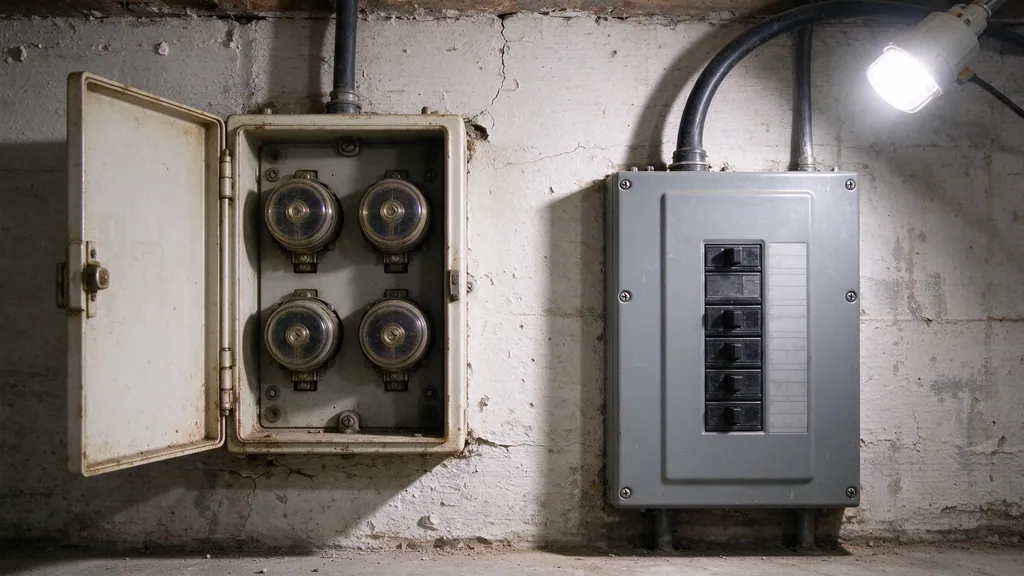
The fuse blows every time someone runs the microwave and the toaster together, or the upstairs goes dark when the space heater kicks on. Your wiring isn’t failing. It’s being asked to carry more than it was built for. Original knob and tube circuits were typically protected at 15 amps, about 1,800 watts, and one space heater or hair dryer can use most of that alone. Because an original circuit often fed a whole floor, a load in one room eats into the capacity of the next.
At Northloom Minneapolis Knob and Tube, we plan new circuits, panels and services for older houses across Minneapolis and St. Paul. This guide walks you through the arithmetic, the fix that makes things worse, and the one that lasts.
Why do my fuses keep blowing?
Because the circuit is doing exactly what it was designed to do: protect the wire. When the total load on a circuit climbs past its fuse, the fuse opens. On an original circuit, “the total load” includes things you might not connect in your head, like the hall light, the bedroom lamp and the bathroom outlet down the hall.
Original circuits run out sooner than modern ones for four reasons.
- Whole floors
- An original circuit often fed several rooms, so a space heater in one room shares capacity with the lights and electronics in another.
- Few outlets
- With one or two receptacles a room, power strips pile several loads onto one outlet.
- Aging connections
- Worn outlets and old splices heat up under load more than new ones do.
- No room to cool
- Runs buried in insulation can’t shed the heat the design counted on.
A blowing fuse is a message, not a malfunction. The useful response is to find out what the circuit actually feeds.
How much can one circuit actually carry?
Watts equal volts times amps. On a 120-volt household circuit, here’s the ceiling, and the lower limit for anything that runs three hours or more.
| Circuit | Maximum | For loads running three hours or more |
|---|---|---|
| 15 amps | About 1,800 watts | About 1,440 watts (80%) |
| 20 amps | About 2,400 watts | About 1,920 watts (80%) |
Original knob and tube circuits were typically 15-amp circuits on 14-gauge copper. The wire sets that limit, not the fuse. That’s why the fuse size matters so much: the fuse is only there to keep the wire inside it.
What do my appliances draw?
| Appliance | Typical draw |
|---|---|
| Space heater | About 1,500 watts |
| Hair dryer | 1,200 to 1,875 watts |
| Microwave | About 1,000 to 1,500 watts |
| Toaster or toaster oven | 800 to 1,500 watts |
| Window air conditioner | 500 to 1,500 watts |
| Vacuum cleaner | 500 to 1,400 watts |
| Laptop and monitor | 100 to 300 watts |
| LED bulb | 5 to 15 watts |
The arithmetic doesn’t leave much slack. A space heater and a hair dryer on one 15-amp circuit go over it. A microwave and a toaster oven on one circuit come close. Add the lights and electronics in the other rooms on that circuit, and an original circuit is overloaded in an ordinary evening.
What does that look like on a winter night?
Picture an upstairs bedroom and the hall beside it on one original 15-amp circuit. The space heater in the bedroom runs at about 1,500 watts. Someone uses a 1,500-watt hair dryer in the hall bathroom, which in many older houses shares that circuit. Together they draw about 3,000 watts on a circuit meant for 1,800. A correctly sized fuse blows within moments. An oversized one doesn’t, and the old wire, its splices and its insulation carry the difference until something gives.
Winter makes it worse here. With a January normal of 16.2°F in the Twin Cities, space heaters come out in cold rooms, and those rooms are often upstairs bedrooms on original circuits. A heater running for hours draws close to the continuous limit of a 15-amp circuit on its own. Add anything else, and the circuit sits overloaded for hours at a time. That’s why upstairs circuits in older houses are often the first ones replaced.
Can’t I just put in a bigger fuse?
No. It’s the most tempting fix and the most dangerous one. A bigger fuse stops the nuisance by removing the protection. A 20- or 30-amp fuse on a 14-gauge circuit lets the wire carry more current than it was made for, with nothing to stop it, and the heat goes into old insulation, old splices and whatever is lying on the wire.
What’s the lasting fix?
New circuits that give heavy loads their own path. When we lay out a rewire, these are the circuits that take the strain off the rest of the house.
- Kitchen
- At least two 20-amp small-appliance circuits for the counters, plus dedicated circuits where appliances need them.
- Bathroom
- A 20-amp circuit for the receptacles, with ground-fault protection.
- Laundry
- Its own 20-amp circuit.
- Bedrooms and living areas
- Circuits that don’t share capacity across a whole floor, with arc-fault protection.
- Big loads
- Dedicated circuits for air conditioning, ranges, dryers and car chargers.
The guide to what replaces knob and tube explains wire sizes and layout.
Will I need a bigger panel too?
Maybe. More circuits and bigger appliances take panel spaces and service capacity. A load calculation adds up what your house runs now and what you plan to run, and sets the service size from that. If a heat pump, an induction range or a car charger is in your plans, do that calculation while the rewire is being planned, so the panel is sized once. Our typical range for a panel and service upgrade is $2,500 to $7,000. The panel upgrade guide explains how panel work relates to the branch circuits.
How do I get by until the rewire?
If your rewire is planned but not done, a few habits take the strain off:
- Run one high-draw appliance per circuit at a time.
- Plug space heaters straight into the wall, never into strips or extension cords.
- Learn which outlets share a circuit, so you can spread your loads.
- Watch for warm covers, dimming lights and burning smells.
- Keep every fuse at its original size.
What about chargers, laptops and TVs?
They’re rarely the problem on their own. Laptops, phone chargers, televisions and LED lighting draw far less than the equivalents of a generation ago. On original wiring, their issue is different: they often want a ground for surge protection, and they multiply on power strips plugged into the few outlets an older room has. New circuits give them grounded outlets where they actually sit.
What if I own a duplex?
In older duplexes, loads can cross units. A basement washer or a stair light ends up on one resident’s circuit, or an outlet in one unit is fed from the other’s fuse box. When one household’s space heater shares a circuit with the other’s laundry, nobody can predict when the fuse will blow. Tracing finds those crossovers, and a rewire puts each unit’s loads on its own panel.
Is there help paying for any of this?
No program pays for the rewire itself. Insulation that cuts your need for space heaters does have rebates once the attic wiring is settled, and a heat pump can bring an Xcel bonus after qualifying insulation and air sealing. The rebates guide keeps track of them. If you’d like to talk through your heaviest circuits: (612) 509-6597.