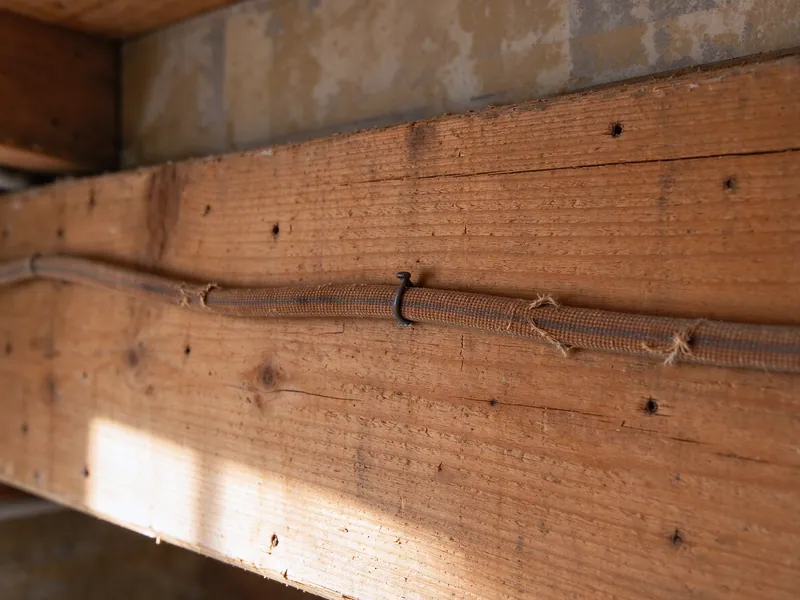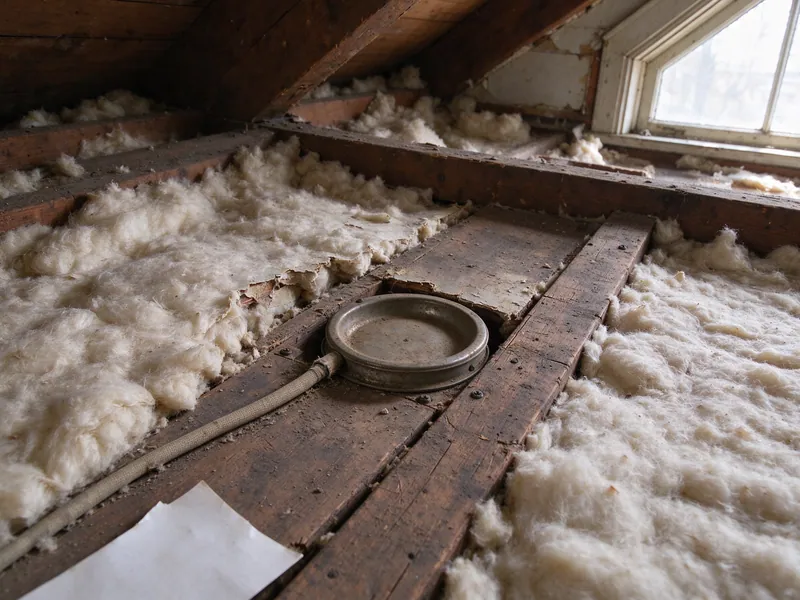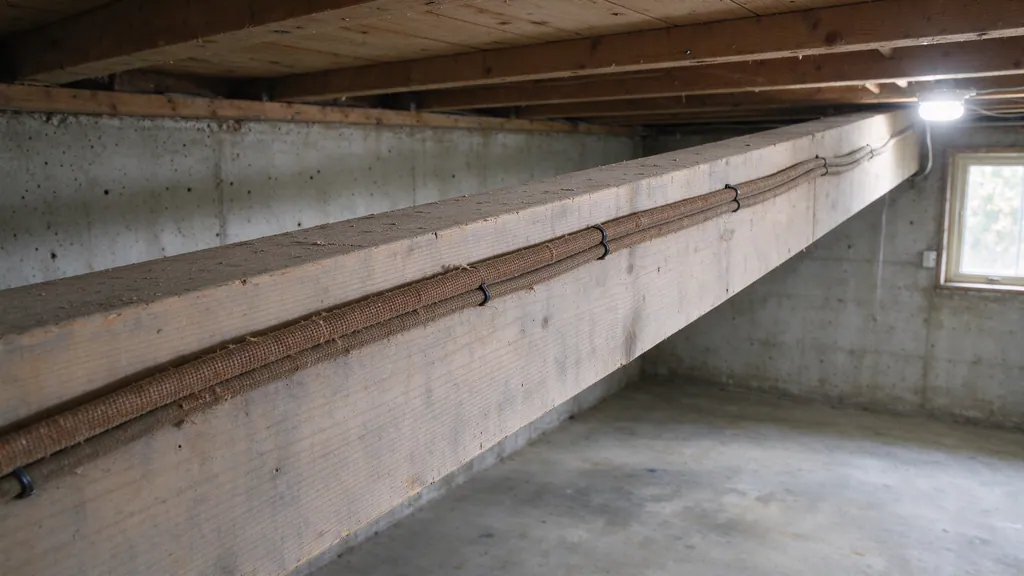
You’ve spotted flat, fabric-covered cable stapled to a basement joist, or a home inspector wrote “cloth wiring” in the report, and now you want to know whether it has to go. Usually it does, and usually it isn’t alone.
At Northloom Minneapolis Knob and Tube, we replace cloth-sheathed wiring in Minneapolis and St. Paul. Cloth-covered cable was the step after knob and tube, and in most older houses you’ll find the two together, often spliced end to end. We trace both before we price anything, so you know which runs are which and where they meet.
What will you look at on the first visit?
We sort every circuit in your house by what it’s made of, because that list is what your scope and price are built on.
- At your panel or fuse box
- We identify each circuit as knob and tube, cloth-sheathed cable or modern.
- Condition
- We check the cloth cable wherever we can see it: at boxes, at fixtures, in the basement and in the attic.
- Splices
- We find the joints between cloth cable and original knob and tube and note each one.
- Grounds
- We test your outlets to see whether any working ground exists.
- Your scope
- You get a written list of the circuits to replace, in the order that makes sense.
How can I tell cloth cable from knob and tube?
They look different, run differently and fail differently.
Knob and tube runs each conductor on its own, held apart from its partner on porcelain, in open air. Cloth-sheathed cable bundles both conductors inside one woven jacket and runs along the framing with staples and through drilled holes, much like the cable we install today. It went in faster and could be fished through walls, which is why it took over.
The timing explains why so many houses here have both. About 42.8% of Minneapolis housing units were built in 1939 or earlier and another 6.0% in the 1940s, the decade when cloth-sheathed cable was replacing open wiring in new houses and remodels. Your 1920s house may have original knob and tube upstairs and cloth cable from a 1940s kitchen downstairs.
The guide to knob and tube versus cloth wiring has photos of each and the places each tends to turn up.
Why does the old insulation crack?
Both systems used rubber insulation on the conductors, and rubber ages. Heat speeds that up, so the worst damage usually sits at the ends of the runs, where you can’t see it.
| Where | What happens |
|---|---|
| Inside light fixtures | Decades of heat from bulbs bake the insulation until it flakes off at a touch |
| At boxes and clamps | Insulation cracks where the cable bends and is handled |
| At switches and outlets | Repeated handling and heat at the terminals wear it through |
| In attics | Summer heat dries out exposed runs |
Because cloth cable keeps both conductors in one jacket, cracked insulation can let them touch inside the cable itself. That’s the main reason we replace it instead of leaving it.
Do I have to replace all of it, or can some be repaired?
That depends on what we find when we trace your circuits.
- Replace
- Circuits on cloth cable with brittle insulation, splices to knob and tube, or ungrounded outlets you need grounded.
- Repair
- A damaged section at one box or fixture, as a stopgap until the circuit is replaced.
- Leave for now
- Cloth cable in good condition on a lightly loaded circuit, written down, while we replace the circuits that matter more first.
A repair keeps the rest of the run in service with no ground and its old splices. It can buy you time, but it isn’t a replacement.
What if one circuit is knob and tube, cloth cable and new wire all at once?
That’s common. Most houses with cloth cable also have knob and tube, with modern cable on top of both. A single circuit can start as knob and tube at the old fuse block, continue as cloth cable to a later kitchen outlet, and end on modern cable at a bathroom fan.
We follow each circuit through every change of wire, so your scope replaces whole circuits instead of whichever section happens to be visible. The mixed wiring guide explains where those joins tend to hide.
Where is the cloth cable likely to be in my house?
Cloth-sheathed cable usually marks a change made between the 1930s and the 1950s, so we find it where houses were updated in those decades.
- Kitchens and baths
- Earlier remodels of the rooms that change most often, sometimes remodeled again since with only the outlets swapped.
- Basement ceilings
- Runs stapled along joists beside original knob and tube, often feeding outlets added upstairs.
- Upstairs ceilings
- Ceiling lights and fans added to upstairs rooms, fed from a nearby original circuit in the attic.
- Old metal boxes
- Shallow boxes with cloth cable clamped at the entry, where bending cracked the insulation.
What about the wiring inside my old light fixtures?
The wire inside an older light fixture often has the same aging rubber insulation, baked by decades of bulb heat. A new circuit doesn’t fix the fixture’s own wiring. If you want to keep a fixture, a lighting restorer can rewire it before it goes back up; others get replaced. Your scope notes which is which, so a new circuit doesn’t end at an old fixture that crumbles the first time it’s moved.
Will my insurer or a buyer ask about it?
Some insurance questionnaires ask only about knob and tube; others ask about “older wiring” in general and count cloth cable. Home inspectors often note both. A written record of what each circuit is made of, what we replaced and what remains lets you answer your agent, and lets a buyer’s inspector answer their own question. Our insurance documentation service covers what carriers usually ask to see.
What will cloth wiring replacement cost?
We price it from your circuit list, the same way we price any rewire. What moves the number is how many circuits there are, how much of the house still runs on cloth cable and knob and tube, how easy your attic and basement are to work from, your plaster and your panel space. Cloth cable often runs through drilled holes, so we can sometimes reuse its routes, which can mean fewer openings than a knob and tube job.
When only some circuits need it, our typical range for partial replacement is $3,000 to $10,000, about $750 to $2,500 a circuit. When most of the house does, our typical range for a whole house is $12,000 to $36,600, before panel work and wall finishing. You get a written estimate from the traced list before anything is booked, and the cost guide breaks the full budget into its parts.
Which circuits do you replace first?
When your house has both cloth cable and knob and tube, we set priorities instead of treating every circuit the same. Circuits with visibly brittle insulation, splices between the two systems, or loads they were never sized for go first. Circuits feeding bedrooms and living areas, where arc-fault protection matters most, come next. Lightly loaded runs in good condition can wait for a later phase if your budget needs that, written down in the meantime.