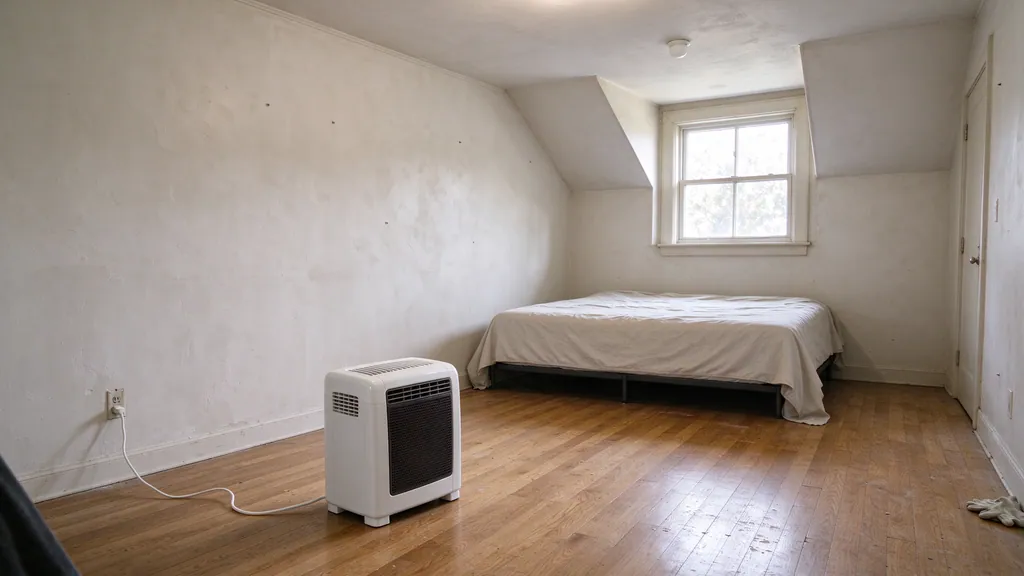
The upstairs bedroom never gets warm, so a space heater goes in every winter. Then the lights dim when it clicks on, or a fuse blows on the coldest night of the week. In an older Minneapolis house, there’s a good chance that bedroom is on an original circuit.
At Northloom Minneapolis Knob and Tube, we replace knob and tube across Minneapolis and St. Paul. This seasonal note covers what a space heater asks of old wiring, and how you can use one more safely until the circuits are replaced.
Why does my heater keep blowing a fuse?
Because it isn’t the only thing on that circuit. Original knob and tube circuits often fed several rooms, so your bedroom’s outlets may share a circuit with the hall, the bathroom and the room next door. The heater is one load among several, in rooms you might not think of as connected.
A blowing fuse is the circuit protecting itself. The tempting fix, a larger fuse, lets old wire carry more current than it was made for, and the heat goes into aging insulation and old joints. If your heater keeps blowing a fuse, the circuit is telling you something, and a bigger fuse just stops it from telling you.
Old outlets add to it. They often grip plugs loosely, and a loose connection heats up under load.
How much does a space heater actually draw?
Most of a circuit on its own. A typical space heater draws about 1,500 watts. A 15-amp household circuit carries about 1,800 watts at most, and about 1,440 for a load that runs three hours or more.
| On the same 15-amp circuit | Approximate draw | Result |
|---|---|---|
| Space heater alone | 1,500 W | Near the continuous limit |
| Heater plus a lamp and a phone charger | About 1,560 W | Over the continuous limit |
| Heater plus a hair dryer | About 3,000 W | Well over the maximum |
| Heater plus a vacuum cleaner | 2,000 to 2,900 W | Over the maximum |
Those heaters run hard here. With a Twin Cities January normal of 16.2°F, a cold room can keep one going for hours at a stretch, which is exactly the continuous load an old circuit handles worst.
How can I use a heater more safely this winter?
Until the circuit is replaced, these habits help:
- Straight into the wall
- Not into a power strip or an extension cord.
- One per circuit
- Learn which outlets share circuits, and don’t run two heaters, or a heater and a hair dryer, on the same one.
- Check the plug
- If the plug or outlet feels warm, stop using that outlet.
- Lower settings
- Many heaters have a low setting that draws much less.
- Never a bigger fuse
- If a fuse blows, unplug something and put back a fuse of the original size.
Can I make the room warmer without the heater?
Often, yes. The longer-term fixes for a cold room can reduce the need for a heater at all. Attic and wall insulation keeps heat in, and Xcel Energy’s rebates pay 40% of qualifying insulation, up to $1,200 each for attic and walls, for customers who heat with Xcel gas or electricity, with air sealing required.
The catch is the wiring. Insulation contractors generally won’t insulate around active knob and tube, so we settle the attic wiring first, and the insulation can follow.
When should I have the circuits traced?
When any of these start happening:
- Fuses or breakers trip regularly in winter
- Lights dim when the heater starts
- An outlet or plug feels warm
- You can’t run the heater without unplugging something else
When we trace your circuits, you see what each one feeds. From there, the scope can add a dedicated circuit for a cold room or replace original circuits outright.
Could one new circuit be enough for now?
Sometimes. Where one room is always cold, a single new grounded circuit for that room, with arc-fault protection, can carry a heater safely while you work out a larger plan.
I rent out a duplex. Should I worry about my residents’ heaters?
It’s worth a look. In older duplexes, one unit’s outlets can share a circuit with the other unit’s rooms or the basement. A resident’s space heater can trip a fuse that darkens a neighbor’s kitchen, or worse, overload a circuit nobody realizes is shared. If you’re hearing about fuses blowing every cold night, that’s a reason to have the building traced.
What should I do before the cold arrives?
Walk through the house in the fall. Note which rooms are coldest, which outlets the heaters will use, and whether those rooms are on original wiring. A knob and tube inspection answers that last question; our typical range for an evaluation is $150 to $500. The guide to appliance loads explains the numbers in more detail. Questions about your house: (612) 509-6597.