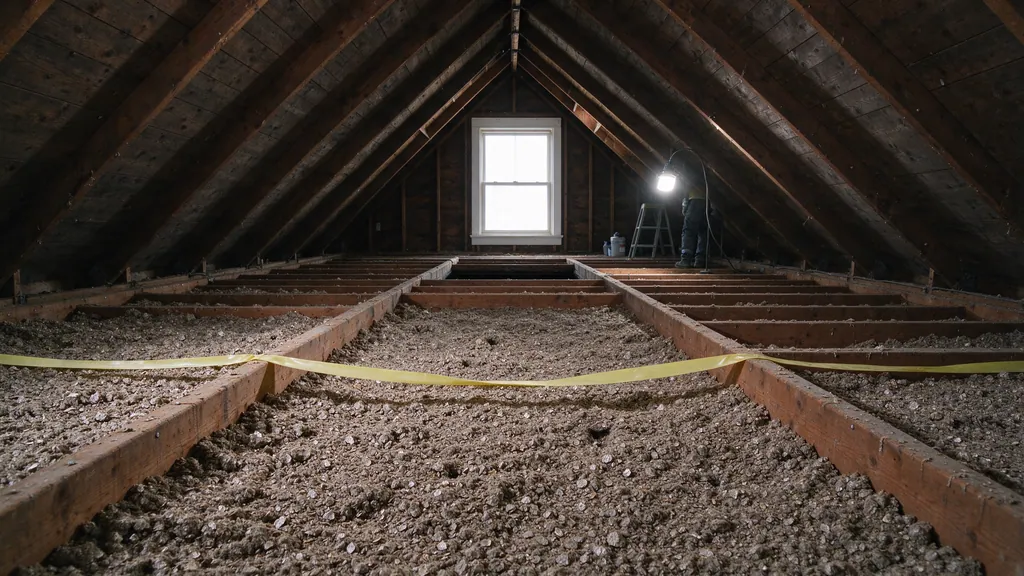
You want the old wiring gone, but your house is old in other ways too. Pebbly fill in the attic, many coats of paint on the plaster, wrap on the basement pipes: a rewire can disturb any of these. If your attic has loose, pebbly insulation, we stop attic work until a sample is tested, and we plan the rest of the job so it doesn’t wait on that.
At Northloom Minneapolis Knob and Tube, we rewire older houses across Minneapolis and St. Paul, and we plan every attic job around this question. This guide shows you what to look for, what happens if it turns up, and how the work still gets done.
Is that pebbly stuff in my attic vermiculite?
It may be. Here’s how vermiculite usually differs from other attic insulation.
| What you notice | Vermiculite | Other common attic insulation |
|---|---|---|
| Texture | Loose, pebbly, like coarse gravel | Fluffy fibers or batts |
| Color | Gray-brown or silvery-gold | White, pink, yellow or gray |
| How it lies | Poured between the joists | Blown in or laid in rolls |
| How to check | Look, don’t touch | Look, don’t touch either |
Look from the hatch with a flashlight. Don’t put your head and shoulders into the attic, don’t reach in, and don’t send anyone up to walk through it. If it looks like the left column, tell us before anyone starts work up there. Only a lab test tells you what it contains.
What happens if you find it?
We stop, and the rest of the plan adjusts around it.
- Stop
- Attic work stops before anyone disturbs the material.
- Test
- Someone qualified takes a sample and sends it to a lab.
- Plan
- If the test confirms asbestos, the plan for that material comes first, usually with a specialist.
- Reroute
- Meanwhile, we can often reach circuits that would cross the attic from the basement or through walls instead.
Many owners discover vermiculite just as they’re getting ready to insulate. Both the wiring and the vermiculite have to be settled before new insulation goes in, and the order matters: test first, then the vermiculite plan, then the wiring, then the insulation.
Why is vermiculite such a concern in Minneapolis?
Because the city has a direct link to it. Western Mineral Products, at 1720 Madison Street NE, processed vermiculite ore from the mine at Libby, Montana, from 1938 to 1989, and much of it was sold as Zonolite attic insulation. The Minnesota Department of Health links that ore to asbestos.
- The plant
- 1720 Madison Street NE, in Northeast Minneapolis, operating 1938 to 1989.
- The ore
- From Libby, Montana, contaminated with asbestos.
- The product
- Sold widely as Zonolite attic insulation.
- The investigation
- The Minnesota Department of Health ran a community investigation in Northeast Minneapolis, and about 268 residential properties were cleaned up.
Vermiculite went into attics across the region, not just near the plant. If your attic has loose, pebbly fill, it gets the same caution whether you live in Northeast or Nokomis.
Will cutting into my plaster stir up lead paint?
It can. Houses built before 1978 may have lead-based paint, and a house built by 1939 may have many layers of it on plaster walls, trim and windows. Our openings are small, but they go through painted surfaces, so we treat each one with care.
- Dust control
- We cut openings cleanly instead of breaking them out, and contain the dust at each one.
- Cleanup
- We clean work areas at the end of each day, not just sweep them.
- Rules
- Federal lead-safe work practice rules apply to many renovations in pre-1978 housing, with thresholds based on the area of paint disturbed.
- Your household
- We keep children and pregnant household members away from work areas.
If you know or suspect lead paint, tell us at the start. It changes how openings are cut, how dust is handled and who does the patching.
What else in an old house should I mention?
Older houses can hold other materials that need care when disturbed: some textured ceiling finishes, old flooring and its adhesive, pipe insulation in the basement, and some old electrical parts. A rewire usually doesn’t touch most of these. But if a route runs through a basement ceiling with old pipe wrap, or a light needs an opening in a textured ceiling, we plan for it. When in doubt, test first.
How do you plan the rewire around these materials?
We work out the routes before the first opening, based on what your house has.
| If your house has | How we plan the rewire |
|---|---|
| Vermiculite in the attic | Attic work after testing and any abatement; meanwhile, routes from the basement and through walls |
| Lead paint | Clean cuts, dust containment, thorough cleanup, careful patching |
| Old pipe insulation in the basement | Routes that avoid disturbing it, or a test first |
| Textured ceilings | Ceiling openings avoided or tested first; lights fed from above |
Why does the order of work matter so much?
Because safety sets the order, not convenience. Testing comes first, since nobody should walk through, drill near or pull wire across vermiculite before knowing what it contains. Any abatement comes next, done by specialists under their own rules. Then the wiring, with the attic safe to work in: original runs confirmed dead or replaced, exposed runs pulled. Insulation comes last, with the electrician’s record in hand. Any other order either exposes people to the material or means opening your attic twice.
Can we keep living at home?
Yes, these precautions fit with staying home. The work still moves room by room, we still close or cover openings each evening, and you keep your routines. If the attic needs abatement, that specialist work may have its own requirements, and you may be advised to spend a short time away while it happens. The guide to living at home during a rewire covers the rest.
Who else needs to know?
If testing confirms asbestos in vermiculite, or you know there’s lead paint, everyone who works in your house should hear it before they start: the electrician, the insulation contractor, the plasterer and the painter. Your household, especially children and anyone pregnant, should know which areas to stay out of and when. We put it in writing in the scope, so the information travels with the job instead of depending on someone remembering to mention it.
When can the new insulation go in?
Once the attic material is dealt with and the wiring is settled. For customers who heat with Xcel Energy gas or electricity, Xcel pays 40% of qualifying attic or wall insulation, up to $1,200 each, with air sealing required. Our attic insulation service explains the sequence.
What paperwork should I keep?
Keep the test results with your house papers, next to the wiring record we give you and any abatement paperwork. A future buyer, insurer or contractor will want to know what was in the attic and what was done about it.
How should I budget for testing and abatement?
Testing is a modest cost. Abatement, if you need it, is priced by the specialist who does it and sits outside our electrical quote. The cost guide lists vermiculite testing among the costs that belong outside the electrical quote. Questions about your attic: (612) 509-6597.