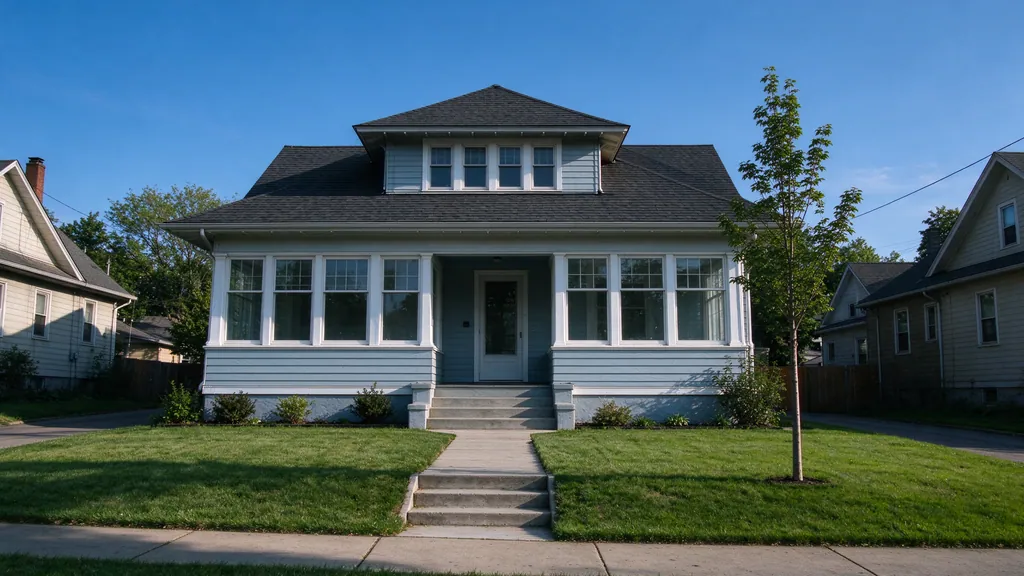
Your house is a story-and-a-half with dormer bedrooms upstairs, the attic runs cold, and an insulation bid, a buyer’s inspector or a new insurer has stopped at the knob and tube. That’s how most calls from Longfellow and Nokomis start.
At Northloom Minneapolis Knob and Tube, we replace knob and tube across Longfellow and Nokomis, from Seward and Cooper down to Keewaydin and Diamond Lake. We treat the two communities together because their houses are built the same way: mostly one or one-and-a-half stories, forced-air heat, an attic above and a basement below. Between those two spaces, new cable can reach most of your rooms, and that keeps the number of wall openings low.
Many houses here have also been updated room by room, so the job is often smaller than the age of the house suggests. That’s why we trace your circuits before we price anything.
What happens when you come out to my house?
We start at the fuse box or panel and work outward, so the price you get rests on what’s actually live in your walls.
- Tracing
- We match every circuit to the rooms it feeds and mark it as knob and tube, cloth-covered cable or modern wiring.
- Attic and basement
- We look at both closely, because in these houses they usually carry most of the new cable, and that’s what keeps openings low.
- Permit
- The permit goes to the Minnesota Department of Labor and Industry, which inspects electrical work in Minneapolis. Getting it in place is part of the job.
- Switch-over
- We bring new circuits live one at a time and keep your furnace on a working circuit the whole way through.
- Record
- You get a written list of what we replaced and disconnected, ready for your insurer or the next buyer.
Is a Nokomis house likely to have less knob and tube than one in Longfellow?
Often, yes, because the age of the housing differs even where the style looks the same. City property records show 85.2% of Longfellow’s one- to three-unit buildings, 7,332 of 8,606, were built in 1939 or earlier. In Nokomis the share is 59.6%, 8,529 of 14,317, with the rest built in later decades.
That difference shows up in the wiring. The later your house was built, the more likely its oldest circuits are cloth-covered cable rather than knob and tube. Both can still be ungrounded and both may need replacing, but they’re handled differently on an insurance form and in a written scope. Tracing tells us which one you have, circuit by circuit.
How will new cable reach my upstairs rooms?
Mostly through the spaces your house already has. Only about 16% of one- to three-unit buildings in either community have two or more stories: 16.1% in Longfellow and 16.3% in Nokomis. Most are one or one-and-a-half stories, often with dormer bedrooms tucked under the roof.
| Part of the house | How we reach it with new cable |
|---|---|
| First-floor walls | Up from the basement ceiling through the bottom plate, or down from the knee-wall attic |
| Upstairs dormer rooms | From the small attic spaces behind the knee walls and above the ceiling |
| First-floor ceiling lights | From the floor above through the knee-wall spaces, or from the attic in one-story houses |
| Kitchens and baths | Usually from the basement, where plumbing walls already have openings in the floor |
Your furnace ducts help too. In Longfellow, 74% of pre-1940 homes heat with forced air and 22% with hot water; in Nokomis, the split is 69% and 28%. The duct chases between floors can sometimes carry cable alongside, which saves an opening when a circuit has to reach upstairs.
Why won’t the insulation contractor work in my attic?
Because the original wiring is lying where the insulation would go. Story-and-a-half houses lose heat through their knee walls and sloped ceilings, and the same attics that make rewiring easier are often the reason you’re calling. The Center for Energy and Environment notes that insulation contractors generally won’t insulate around active knob and tube.
- Wiring first
- We confirm the original attic runs dead or replace them, and give you a record to hand the insulation contractor.
- The rebate
- Xcel Energy pays 40% of qualifying attic or wall insulation, up to $1,200 each, for customers who heat with Xcel gas or electricity, with air sealing required.
- One trip into the attic
- When we settle the wiring just ahead of the insulation crew, your attic only gets opened once.
The attic insulation service explains the sequence, and the rebates guide tracks the current terms.
In what order do you rewire a story-and-a-half?
The layout of these houses sets the order. We usually put in the first-floor circuits first, from the basement, where the ceiling is open and the panel sits. The upstairs dormer rooms follow, from the knee-wall attics. We clear the attic floor last, once every original circuit that crossed it has been replaced, so your insulation contractor can follow straight after.
Do I need the whole house rewired, or just part of it?
In Longfellow and Nokomis, often just part. Earlier owners tended to update these houses piece by piece: a kitchen in one decade, a bathroom in another, a finished basement later. When we trace, the remodeled rooms are frequently on modern cable already, while the bedrooms and the upstairs still hang off one or two original circuits.
For a house like that, partial replacement is usually the right job, and we write down the boundary between new and old wiring so your insurer can see it. The partial versus full guide walks through how to decide.
What if I own a duplex or a rental here?
Most of what we rewire in this part of the city is single-family. Longfellow has 1,348 active rental licenses and Nokomis 1,549, fewer than the older, denser communities to the north and west, and there are fewer two- and three-unit buildings: 691 built by 1939 in Longfellow, 286 in Nokomis.
If your duplex needs rewiring, Minnesota’s homeowner permit is off the table, because it covers only an owner-occupied single-family home. The permit for a rental is filed as part of the job. We trace each unit separately and schedule the outages with the residents of each one.
Does living in a historic district change anything?
Two designated districts fall in this part of the city: Milwaukee Avenue in Seward, a street of small brick workers’ houses, and the Minnehaha district around the falls. Interior rewiring is mostly out of sight. For any exterior change, such as a new service mast or meter location, we confirm with the city for your address before we design the job.
What will the permit cost?
The Minnesota Department of Labor and Industry inspects electrical work here. A rewire of 15 to 30 circuits in an existing one-family home carries a $191 state fee, or $226 with a new service, and the request for inspection goes in at or before the start of work. The cost guide covers the whole budget, including illustrative figures for a story-and-a-half bungalow.