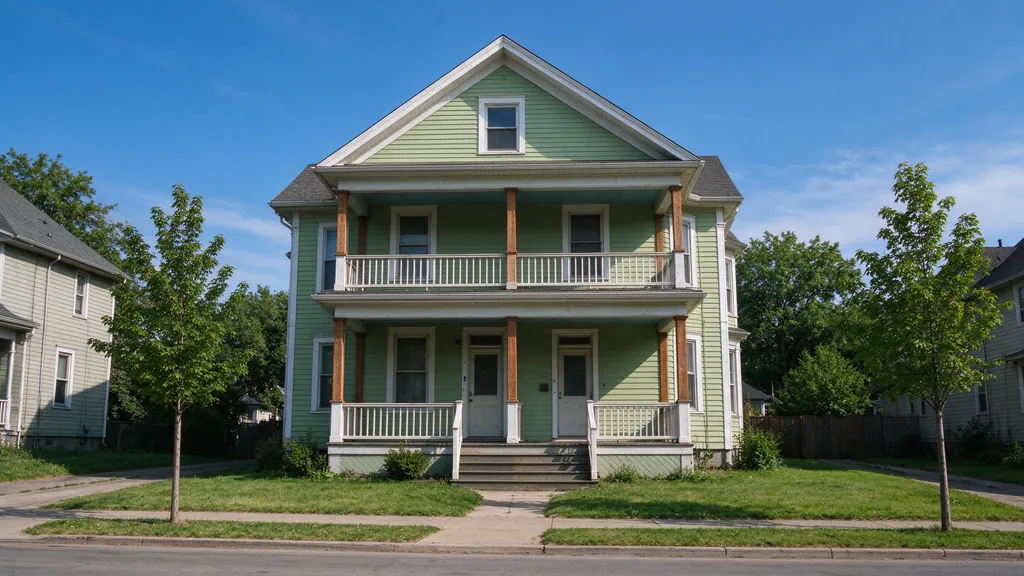
You own an up-and-down duplex with two fuse boxes and a basement circuit nobody can explain. Or your attic has loose, pebbly fill lying over the original wiring, and the insulation bid is on hold. Or a rental renewal letter wants to know, unit by unit, whether any knob and tube is still live. Those are the jobs we see most in Northeast.
At Northloom Minneapolis Knob and Tube, we replace knob and tube across Northeast Minneapolis, from St. Anthony East and Logan Park near the river up to Columbia Park, Waite Park and Audubon Park. Northeast has more older duplexes and triplexes than anywhere else in the city, and a history with attic vermiculite that we account for on every attic job here.
We trace every circuit before we price the work, so you know what’s still live before you decide anything.
What do you do on the first visit?
We work through the building one unit at a time, and we look at the attic before anyone climbs into it.
- Unit by unit
- We trace each unit’s panel or fuse box to its own rooms and find any crossovers between units.
- Attic check
- We look at the existing insulation from the hatch and flag loose, pebbly fill before anyone walks through it.
- Permit
- The permit goes to the Minnesota Department of Labor and Industry, which inspects electrical work in Minneapolis. Getting it in place is part of the job.
- Residents
- We schedule the work one unit at a time and give you dates and outage windows so you can notify your residents.
- Record
- You get a written record for each unit and for the building.
Why does my duplex need to be traced unit by unit?
Because each unit has its own wiring history. Northeast’s older multi-unit buildings usually have an upper and lower unit, sometimes a third, each with its own fuse box or panel and meter. Over the decades, owners changed each unit’s wiring separately, and the basement, stairs and laundry often ended up on whichever unit’s circuit was closest.
| What tracing often finds | What we do about it |
|---|---|
| Lower unit rewired, upper unit still original | Set the scope unit by unit; the upper unit may need far more |
| A basement circuit fed from the upper unit | Move it to a house panel or the correct unit |
| Two fuse boxes, no spare capacity | Plan panels for both units before new circuits go in |
| Shared stair lighting on one unit | Move it to a house circuit so neither resident pays for it |
There are a lot of these buildings here. City property records count 6,821 one- to three-unit buildings in Northeast built in 1939 or earlier, 63.3% of 10,780. Of those, 2,087 are two- and three-unit buildings, the most of any Minneapolis community, and Northeast has 3,099 active rental licenses, second only to Powderhorn.
Minnesota’s homeowner electrical permits can’t be used on a duplex or triplex, so the permit is filed as part of the job, and the state fee is figured per dwelling unit. The duplex rewiring page covers our method in detail.
Is the insulation in my attic dangerous?
It might be, and you should treat it that way until it’s tested. Northeast has a specific history with attic insulation. Western Mineral Products, at 1720 Madison Street NE, processed vermiculite ore from Libby, Montana, sold as Zonolite attic insulation, from 1938 to 1989. The Minnesota Department of Health links that ore to asbestos and ran a community investigation in Northeast Minneapolis, where about 268 residential properties were cleaned up.
Where we can, we plan the electrical routes to leave it alone, using basement and wall routes for circuits that would otherwise cross the attic. The guide to asbestos, lead and vermiculite explains testing.
How do you get cable to the upper unit?
Usually through the lower unit’s closets and chases, chosen to disturb the household living there as little as possible. Most Northeast houses are one to two stories: 34.4% of one- to three-unit buildings have two or more stories, and 68% of pre-1940 homes heat with forced air, against 25% hot water. Those duct chases help us carry cable between floors.
What about a single-family house in Northeast?
Not every Northeast job is a duplex. Most of the community’s 10,780 one- to three-unit buildings are single-family houses, many of them modest one-and-a-half story homes with an attic above and a basement below. We rewire those the way we do any story-and-a-half: first-floor circuits from the basement, upstairs rooms from the knee-wall attics, and the attic floor cleared last, once the vermiculite question is answered.
What will my insurer or a buyer want to see?
Landlord policies often ask whether any knob and tube is energized, unit by unit, and the building record we give you answers that. At sale, a buyer’s inspector or the city’s sale evaluation may note original wiring. What Minneapolis’s evaluation requires for your house, we confirm with the evaluator. TISH electrical repairs covers the common items, and the insurance guide covers what carriers ask.
How much is the permit?
The Minnesota Department of Labor and Industry inspects electrical work in Northeast. For an existing one-family home, a rewire of 15 to 30 circuits carries a $191 state fee, or $226 with a new service; multi-unit buildings are figured per unit. The permit guide walks through the steps, and the cost guide covers the budget.
When can the attic finally be insulated?
As soon as the attic wiring is settled and any vermiculite question is answered. Then the rebate can help: Xcel Energy pays 40% of qualifying attic or wall insulation, up to $1,200 each, for customers who heat with Xcel gas or electricity, with air sealing required. In a duplex, each unit’s account and heating fuel decide eligibility.