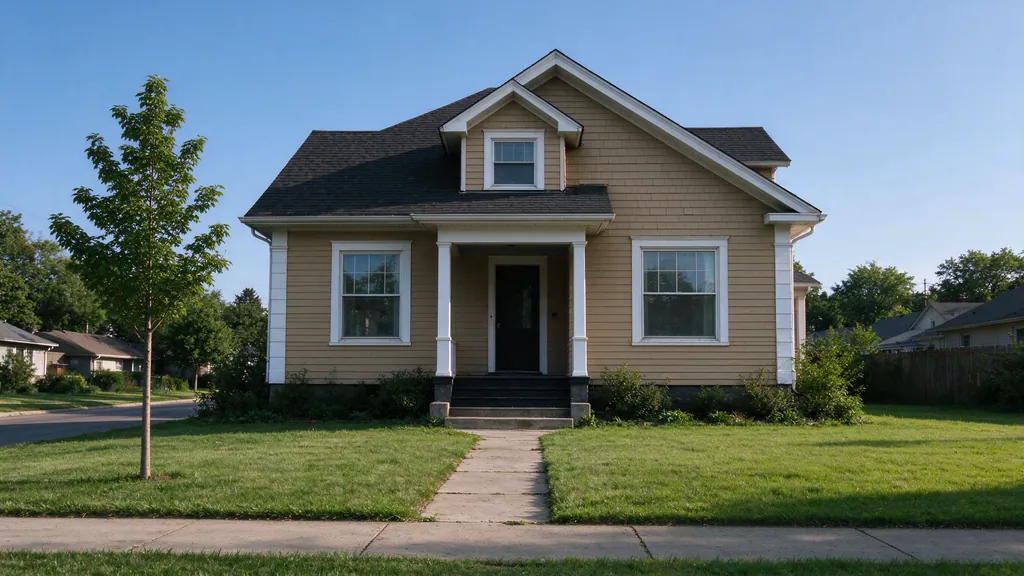
Maybe you bought a small house in Camden and the fuse box is still in the basement. Maybe your insurer wants to know if any knob and tube is live before it renews, or the upstairs of your Near North two-story still runs on original circuits behind plaster. Each of those is a different job, and the first step is finding out which one you have.
At Northloom Minneapolis Knob and Tube, we replace knob and tube across North Minneapolis, from Willard-Hay and Jordan near Theodore Wirth Park up to Webber-Camden and Shingle Creek. Near North and Camden share this page, but their houses are built differently, and we plan the rewire around the house you actually have.
A lot of houses up here have been partly updated over the years, so the work is often smaller than a whole-house rewire. We trace your circuits before we price it.
What will you look at first?
Your fuse box or panel, then the attic and basement. That tells us what’s still on original wire and how new cable can reach it.
- Tracing
- We identify every circuit at the fuse box or panel, since many houses here have been partly updated.
- Scope
- Often that’s a partial replacement of the circuits still on original wire, plus the panel changes they need.
- Permit
- The permit goes to the Minnesota Department of Labor and Industry, which inspects electrical work in Minneapolis. Getting it in place is part of the job.
- Switch-over
- We bring new circuits live one at a time and keep your furnace on a working circuit.
- Record
- You get a written list of what we replaced and disconnected.
Why does it matter whether I’m in Near North or Camden?
Mostly because of height. A taller house means more floors for cable to cross, and that changes how we route it.
City property records show 69.0% of Near North’s one- to three-unit buildings, 4,877 of 7,064, were built by 1939, and 61.5% of Camden’s, 6,229 of 10,122. Together that’s 11,106 buildings built in 1939 or earlier. Near North’s include 90 built before 1900; Camden’s, 124.
| Measure | Near North | Camden |
|---|---|---|
| Built by 1939 | 69.0% | 61.5% |
| Two or more stories | 38.4% | 10.3% |
| Main heat, pre-1940 homes | 58% forced air, 36% hot water | 79% forced air, 15% hot water |
| Two- and three-unit buildings built by 1939 | 966 | 346 |
| Active rental licenses | 2,310 | 1,790 |
How do you rewire a smaller Camden house?
In Camden, nine of ten of these buildings are under two stories, and most heat with forced air. A one-story or story-and-a-half house with an open attic and basement is the easiest kind to rewire. We bring first-floor circuits up from the basement, feed ceiling lights and upstairs rooms from the attic, and follow the duct chases where cable has to cross between floors.
And a Near North two-story?
Near North has more two-story houses and more radiator heat, so there are fewer ducts to follow. We reach the upstairs rooms through closets and stacked walls, and the route survey does more of the work before any wall is opened.
What if only a few circuits are still original?
Then you likely need a partial job, not a whole-house rewire. Because so many houses here have been updated in stages, that’s a common outcome. Partial replacement explains how we draw the boundary between new and old wiring and write it down for you.
A smaller job also means a smaller permit. Below 15 circuits, the state charges $12 a circuit with a $55 minimum per inspection trip, plus a $25 permit fee and $1 surcharge, so a 10-circuit job with two inspection trips comes to $146.
Can I keep my fuse box?
Usually not for the new circuits. They need arc-fault and ground-fault protection, which a fuse box can’t provide, so even a partial job usually adds a breaker panel or a subpanel. If you’re planning air conditioning or a heat pump, we run a load calculation before the service is sized.
The panel upgrade page covers the steps, and the guide to panel upgrades versus knob and tube replacement explains why a new panel by itself doesn’t take the original wiring out of service.
Minnesota has created a residential panel upgrade grant for income-qualified households, but it isn’t accepting applications yet. The rebates guide tracks its status.
Can I insulate my attic first?
Not while original wiring is live up there. The attics of Camden’s smaller houses are where original runs most often survive, and where insulation does you the most good. We confirm those runs dead or replace them first, and give you a record for the insulation contractor.
Then the rebate can follow: Xcel Energy pays 40% of qualifying attic or wall insulation, up to $1,200 each, for customers who heat with Xcel gas or electricity, with air sealing required. The attic insulation service explains the sequence.
I own a duplex. How does that work?
North Minneapolis has a large rental stock: 2,310 active rental licenses in Near North and 1,790 in Camden, and 966 and 346 two- and three-unit buildings built by 1939. We rewire a duplex unit by unit. We trace each unit to its own panel, separate any crossovers between units, and schedule the work around the residents.
Minnesota’s homeowner permit covers only an owner-occupied single-family home, so it can’t be used on a duplex; the permit is filed as part of the job. Landlord policies often ask whether any knob and tube is energized in each unit, and the record you get at the end answers that. The duplex rewiring page covers the details.
Does Victory Memorial Drive’s historic status affect my house?
Victory Memorial Drive, along the western edge of Camden, is one of the city’s designated historic districts. Interior wiring is mostly out of sight. For any exterior change near it, such as a new meter location or service mast, we confirm with the city for your address before we design the job.
What does the permit cost for a whole house?
The Minnesota Department of Labor and Industry inspects electrical work here. A whole-house rewire of 15 to 30 circuits in an existing one-family home carries a $191 state fee, or $226 with a new service. The request for inspection goes in at or before the start of work. The cost guide covers the full budget.
Can we stay in the house while you work?
Yes, most people do. In a one-story or story-and-a-half house, we work from the basement up, and your rooms come back onto new circuits one after another. Your furnace stays on a working circuit throughout, we cover floors, and we close or protect openings each evening.